

The fastest way to buy the right jump starter is to match its engine-size rating to your vehicle, not chase the highest peak-amp number on the box. Most drivers do fine with a compact lithium unit rated for standard gas engines, while owners of trucks, diesels, or fleets need more sustained cranking power. A curated automotive selection can sort these by vehicle type, so you’re not guessing.
TL;DR:
- Matching the jump starter’s engine-displacement rating to your vehicle provides more reliable performance than solely focusing on peak-amp numbers.
- Compact lithium jump starters rated for small engines work well for everyday passenger cars, but larger vehicles and diesel trucks require higher capacity, lead-acid, or heavy-duty units.
- Peak amps are often exaggerated; real-world cranking power typically ranges from 40% to 75% of the advertised peak, especially in cold weather.
- Build quality, cable and clamp durability, and proper maintenance are more critical for reliability than the raw peak-amp rating or extra features.
- Buyers should prioritize matching the unit to their vehicle’s size, ensure proper maintenance, and choose a model with quality clamps and cables for long-term dependability.
Table of Contents
- What Are the Best Car Jump Starters by Use Case?
- How Do You Choose the Right Jump Starter for Your Car?
- How Do You Use a Jump Starter Safely?
- What Does the Testing Actually Show?
- An Editor’s Take on What Actually Matters
- Where to Buy a Jump Starter That Actually Matches Your Car
- Sources
- FAQ
What Are the Best Car Jump Starters by Use Case?
You don’t need the biggest jump starter on the shelf. You need the right one for your car, your climate, and how often you’ll actually use it. Here’s how the categories break down.
Compact everyday-carry (glovebox class)
If you drive a sedan, hatchback, or compact SUV and just want peace of mind in the glovebox, this is your category. Look for units in the 1,000 to 2,000 peak-amp range weighing under three pounds. The NOCO Boost Plus GB40 is the benchmark here: about 2.45 pounds, roughly 1,000 peak amps, and typically priced under $100. It fits in a door pocket or center console and starts most four-cylinder and V6 gas engines without drama.
These units trade raw power for size. That’s fine for a Civic or a Camry. It’s not fine for a diesel pickup, which brings us to the next tier.
Mid-power all-purpose (SUV and light truck class)
Owners of midsize trucks, three-row SUVs, and larger V6 or small V8 engines should look for units rated 2,000 to 3,000 peak amps. This class typically adds better cable gauge, sturdier clamps, and sometimes a built-in air compressor or flashlight. Expect prices in the $80 to $180 range. This is the sweet spot for most American households that own at least one larger vehicle, since a compact unit rated for a Corolla often struggles with a Tahoe on a cold morning.
Heavy-duty, diesel, and shop use
Large diesel trucks, commercial vans, and fleet vehicles call for a different approach entirely. Independent testing shows lead-acid boosters still outperform lithium packs for repeated heavy-duty starts, largely because they don’t need recharging between jumps the way a depleted lithium pack does. Shop-style units like those in the Clore Jump-N-Carry line tested by Car and Driver deliver high, repeatable cranking output but weigh considerably more and need a dedicated spot in a garage or service truck. If you’re jumping vehicles multiple times a week, that weight penalty is worth paying.
For big lithium units aimed at large-displacement engines, the NOCO Boost X GBX155 claims 4,250 peak amps and coverage up to 10.0-liter gas or 8.0-liter diesel engines. That’s real capability, but the number on the box is still a peak figure, not a promise of how it performs on the fifth cold start of the week.
Multi-function power stations
Combo units that pair a jump starter with an air compressor and AC or USB outputs are genuinely handy for road trips, tailgating, or job sites where you need more than a jolt of amps. Road & Track’s 2026 testing found these combo units useful for planned multi-use scenarios, but they run heavier and demand more frequent maintenance charging than a single-purpose starter. If your primary need is “get my car started,” a dedicated jump starter beats a bulkier all-in-one. If you’re outfitting a truck for camping or overlanding, a portable power station with jump-start capability might replace three separate gadgets in your trunk.
Here’s the shortlist in one glance:
- Compact everyday: 1,000 to 2,000 peak amps, under 3 lbs, for sedans and small SUVs
- Mid-power all-purpose: 2,000 to 3,000 peak amps, for trucks and larger SUVs
- Heavy-duty/diesel: lead-acid or 3,000 to 4,000+ peak-amp lithium, for fleets and shops
- Combo power stations: added compressor/AC outputs, best for planned multi-use trips
How Do You Choose the Right Jump Starter for Your Car?
Peak amps are the number every manufacturer prints in bold on the packaging, and it’s also the number that misleads the most buyers. Testing summarized by CarCareTruth found that sustained cranking power typically runs 40% to 75% of the advertised peak amp figure under lab conditions. A jump starter rated at 2,000 peak amps might only deliver 800 to 1,500 amps of the real, sustained current your engine needs to actually turn over.
Peak amps measure a brief burst, often just milliseconds long, under ideal temperature and voltage. Real-world cranking depends on the battery’s internal resistance and the ambient temperature, which is why field testers recommend adding 20% to 50% headroom to your calculated needs if you live somewhere cold. This is also why matching by engine-size rating beats matching by amp number. Manufacturers test their units against specific engine displacements and publish that rating for a reason: it accounts for the messy variables that a peak-amp number ignores.
Engine-size reference for buying
Here’s a rough guide for matching amp class to engine type, based on how most manufacturers rate their products:
Treat this table as a starting point, not gospel. Cold climates push you toward the higher end of each band, and an older battery with more internal resistance needs more headroom than a fresh one.
Chemistry tradeoffs: lithium, lead-acid, and supercapacitors
Lithium jump starters dominate the compact and mid-power categories because they’re light, hold a charge for months, and pack surprising power into a small footprint. Their weakness shows up in cold weather: lithium cells lose efficiency as temperatures drop, which is exactly when you’re most likely to need a jump. Lead-acid units don’t have that problem to the same degree and can deliver repeated starts back to back without recharging, which is why Car and Driver’s testing still favors them for shop environments where one unit might jump five vehicles in a shift.
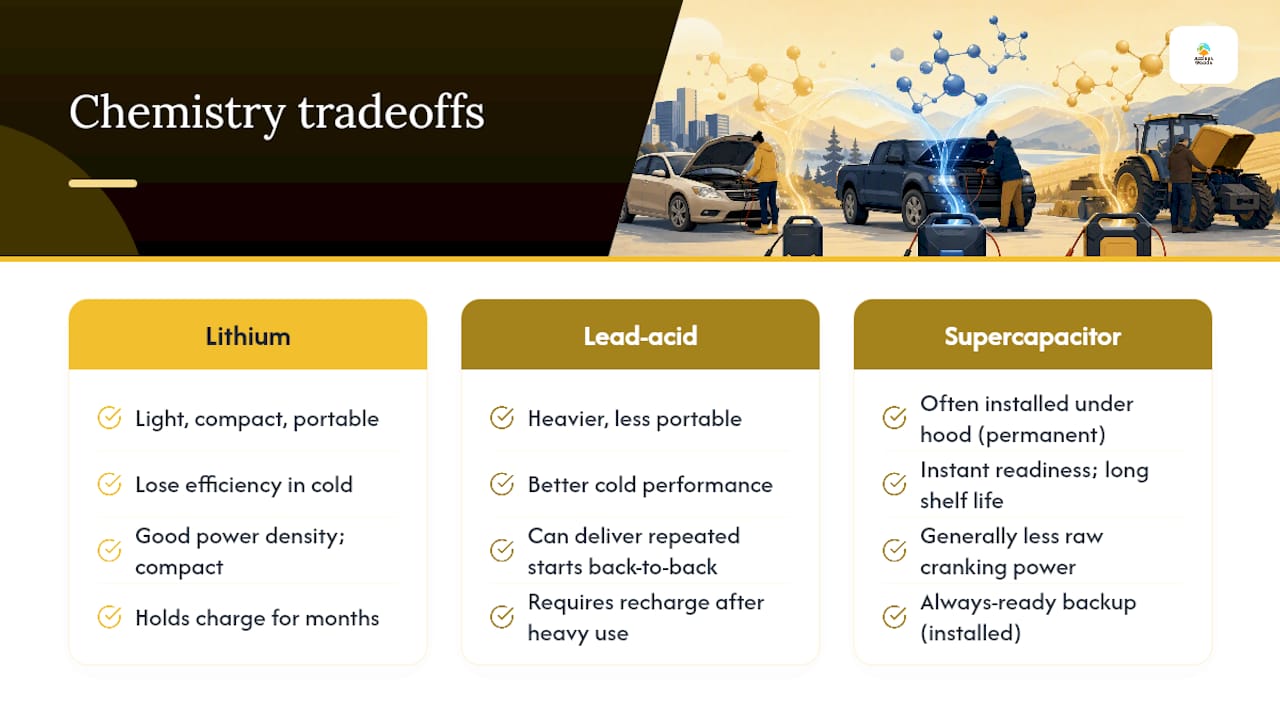
A smaller category worth knowing about: supercapacitor-based units like the ANCEL BS200, designed to live under the hood permanently as an always-ready backup. They offer instant readiness and a long shelf life, but generally deliver less raw cranking power than a large lithium pack. They’re a niche pick for someone who wants a “install it and forget it” backup rather than a portable tool they carry between vehicles.
Cables, clamps, and build quality
Testers across multiple reviews keep landing on the same overlooked point: clamp and cable quality often matters more for real-world usability than a slightly higher amp rating. A jump starter with thin cables and flimsy clamps can struggle to make solid contact on corroded terminals, no matter what the peak-amp sticker says. When comparing models, check for:
- Cable length of at least 20 inches for easier positioning around tight engine bays
- Spring-loaded clamps with wide jaw openings for corroded or oversized terminals
- An IP54 or higher rating if you’ll store the unit in a garage, trunk, or anywhere humid
- A stated operating temperature range that covers your region’s winter lows
What price actually buys you
Budget units under $60 typically cover small engines only, skip the safety electronics, and use thinner cables. Mid-tier units from $80 to $180 add reverse-polarity protection, better build quality, and often a flashlight or USB ports. Premium units above $200, including large lead-acid boosters and high-capacity lithium packs like the GBX155, buy you diesel and large-displacement coverage plus the durability to survive years of use in a truck bed or shop.
Pro Tip: Buy one class above what you think you need. A $30 price jump between the compact and mid-power tier is cheap insurance against a dead battery on the coldest morning of the year.
How Do You Use a Jump Starter Safely?
Every jump starter ships with instructions, but the sequence matters more than most people realize, and getting it backward can damage a vehicle’s electronics.
Before you touch a clamp, check three things: make sure the jump starter itself has charge, confirm both vehicles are in park with engines off, and clear the area of anything flammable near the battery. If you’re opening the hood for the first time in a while, this is also a good moment to check for corrosion or debris around the battery terminals. A build-up of grime there is often a bigger problem than most drivers realize, and it’s worth a look at safe engine-bay cleaning steps if things look neglected.
Here’s the hookup and start sequence:
- Turn off the jump starter and make sure it’s unplugged from any charger.
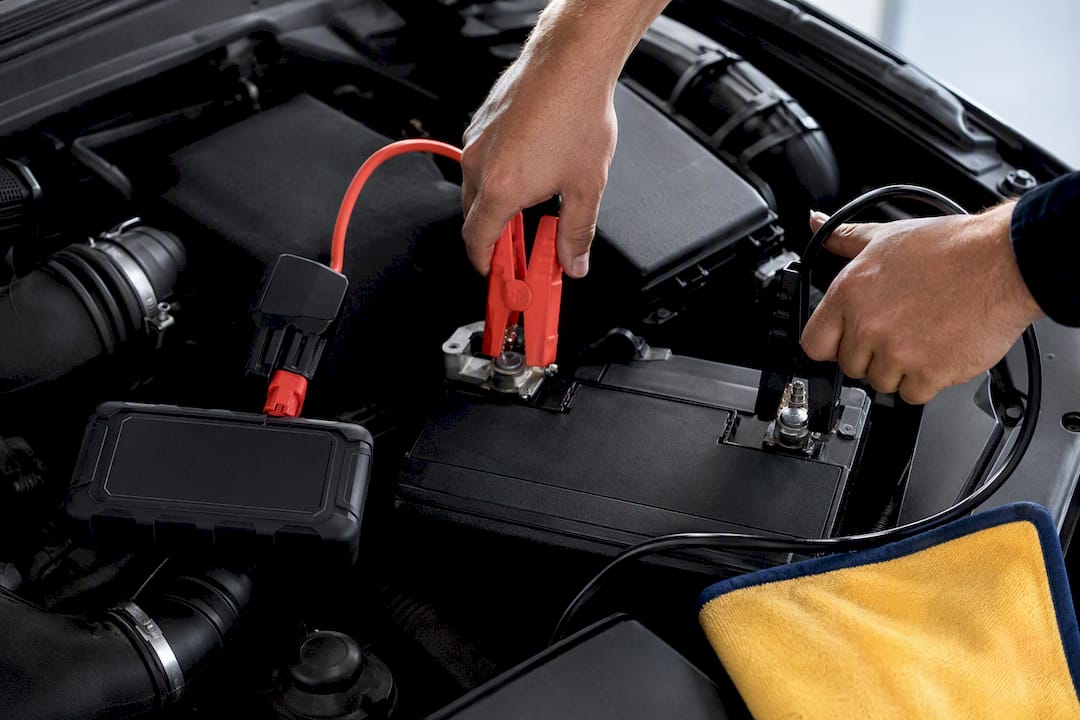
- Connect the positive (red) clamp to the positive terminal on the dead battery.
- Connect the negative (black) clamp to a solid, unpainted metal ground point away from the battery, not directly to the negative terminal, unless the manufacturer’s manual specifically says otherwise.
- Power on the jump starter.
- Wait 30 to 60 seconds to let some charge flow into the dead battery before attempting a start.
- Try starting the vehicle. If it doesn’t catch within 5 to 8 seconds, stop and wait another minute before trying again.
- Once the engine starts, disconnect the clamps in reverse order: negative first, then positive.
- Let the jump starter cool for a few minutes before storing it back in its case.
If the battery is completely dead (no dash lights, no clicking), give the jump starter more time connected before attempting a start, since a fully depleted battery needs a longer charge window than a partially drained one. For vehicles with sensitive electronics, hybrids, or anything with a stop-start system, check the owner’s manual first. Some manufacturers specify particular jump points that aren’t the main battery terminals.
Common failure modes include reversed polarity warnings (stop immediately and recheck your clamp placement), a jump starter that won’t power on in cold weather (lithium units especially struggle below freezing; warm the unit in your pocket or cabin first), and clamps that spark excessively on contact, which usually signals a loose connection rather than a starter malfunction.
What Does the Testing Actually Show?
Reviewers testing jump starters in 2024 through 2026 generally run the same core battery of checks: cold-start success rate, number of jumps possible on a single charge, performance in low temperatures, and how the clamps and cables hold up after repeated use. These metrics matter more than a single headline number because they reveal how a unit behaves after the first jump, not just the first one.
The pattern across independent labs has been consistent. Compact lithium starters handle daily-driver duty well, peak-amp figures routinely overstate real sustained cranking power, and lead-acid units continue to win on repeated heavy-duty starts where a unit needs to jump multiple vehicles without a recharge break.
Independent tests conducted between 2024 and 2026 found that compact lithium starters suit the vast majority of passenger vehicles, while lead-acid or high-capacity units remain the more reliable choice for repeated heavy-duty starts and professional shop use.
What should a buyer actually trust when reading spec sheets and reviews? A few signals hold up better than others:
- The manufacturer’s stated engine-displacement rating, since it’s tested against real starting conditions rather than a lab burst
- Independent test reports that measure jumps-per-charge, not just a single successful start
- Clamp and cable build quality noted in hands-on reviews, since that’s where cheaper units usually fail first
- Cold-weather performance data, if the reviewer tested it, since that’s when most real jump starts happen
The practical takeaway: don’t shop by the biggest number on the box. Shop by matching the unit’s tested engine coverage to your actual vehicle, and weight independent hands-on testing over marketing copy.
An Editor’s Take on What Actually Matters
Most buying guides treat jump starters as a spec-sheet contest, biggest peak-amp number wins. That framing gets people in trouble. A driver who buys a 3,000-peak-amp unit for a Honda Civic isn’t better protected than one who bought a properly rated 1,200-amp compact model. They’re just carrying extra weight and paying for capability they’ll never use.
The bigger blind spot is maintenance. A jump starter sitting untouched in a trunk for eight months isn’t a safety net, it’s a brick. Lithium units lose charge slowly over time, and a unit that hasn’t been topped up in half a year may not have enough juice left when you actually need it on a freezing morning. Recharge every few months, check the display before long trips, and store the unit somewhere that doesn’t swing between extreme heat and cold.
What I’d prioritize, in order: build quality of the clamps and cables first, since that’s what fails in daily use; an engine-size rating that matches your vehicle with some headroom, second; and only then the brand name or extra features.
A basic kit worth keeping alongside the unit itself:
- The jump starter, fully charged
- Its charging cable
- A hard case to prevent clamp damage in a trunk
- A pair of basic work gloves
- A terminal cleaner brush for corroded posts
- A laminated quick-start card taped to the case, for anyone else who might need to use it
— Matthew Vista
Where to Buy a Jump Starter That Actually Matches Your Car
An automotive selection sorted by similar logic includes compact units for daily drivers, mid-power picks for trucks and SUVs, and heavy-duty options for diesels and fleet use, so you’re picking from a shortlist that already fits your vehicle instead of scrolling through hundreds of unranked listings.
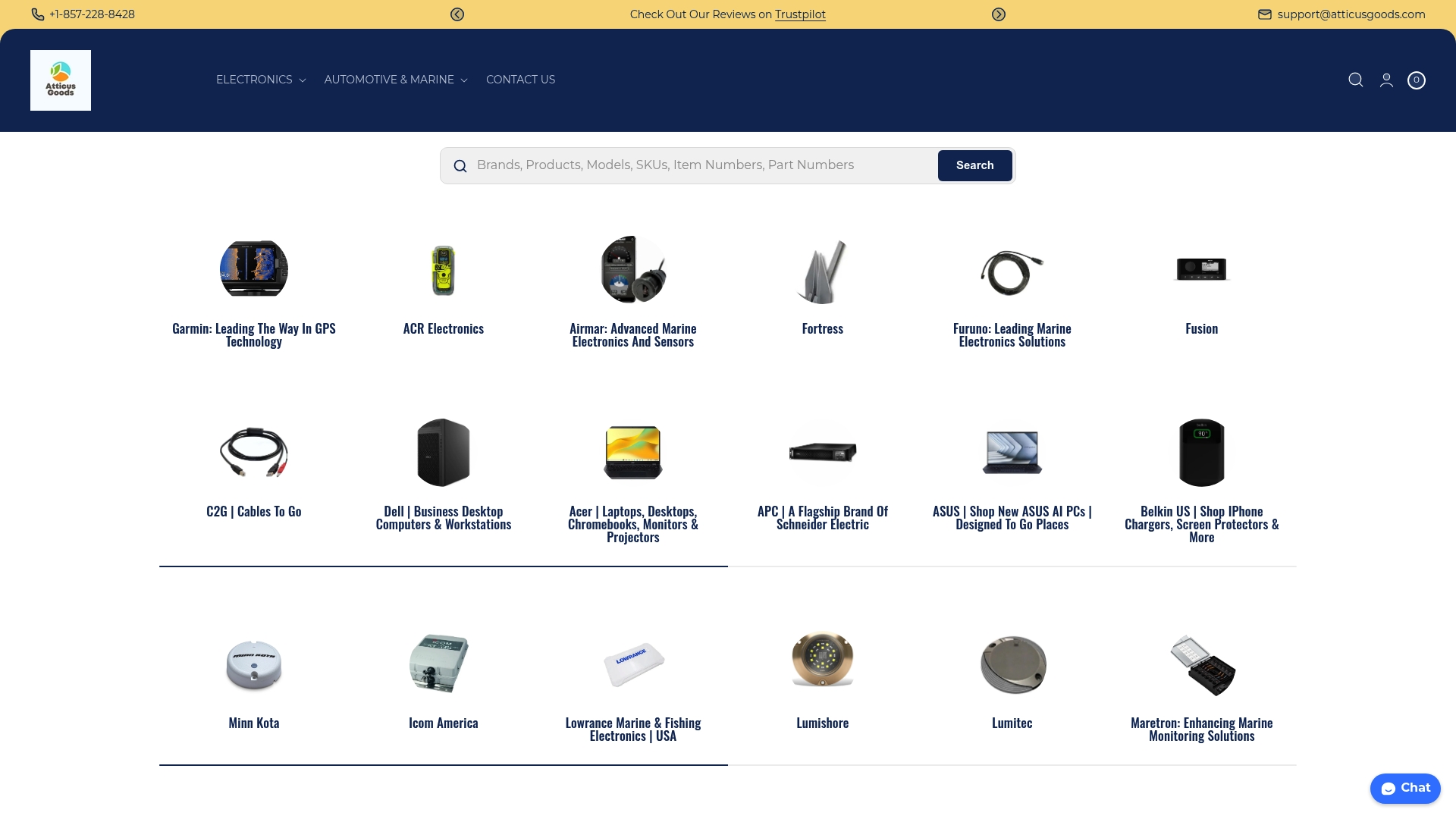
The advantage isn’t just curation. Atticus Goods stocks deep inventory across Automotive & RV, Marine & Boating, and Powersports categories, with fast, next-day shipping on in-stock items across the country, so a dead battery this week doesn’t turn into a two-week wait for a replacement jump starter. If you’re also outfitting a truck or camper with backup power, the same next-day shipping applies to power inverters and other 12-volt accessories that pair well with a jump starter kit.
Browse the full Atticus Goods catalog to find a jump starter matched to your engine size and get it shipped fast, backed by responsive customer support if you have questions before you buy.
Sources
- Tested: Best Portable Jump-Starters | Car and Driver
- Best Portable Jump Starters of 2026, Tested and Reviewed | Road & Track
FAQ
Which car battery jump starter is best?
There’s no single best unit for every car. Compact lithium starters like the NOCO Boost Plus GB40 suit most daily drivers, while trucks, diesels, and fleet vehicles need higher-capacity or lead-acid units for reliable repeated starts.
Which jump starter is best for my car?
Match the unit to your engine’s displacement rating rather than the peak-amp number on the box. A 4-cylinder or V6 gas engine typically needs 1,000 to 2,000 peak amps, while V8s and diesels need 2,000 to 4,000 peak amps or more.
What is the best car jump starter pack?
For most passenger vehicles, a compact lithium pack in the 1,000 to 2,000 peak-amp class offers the best mix of portability and capability. Atticus Goods’ automotive selection groups these by vehicle type to simplify the choice.
What is the most powerful car jump starter?
Among widely reviewed units, the NOCO Boost X GBX155 ranks among the most powerful, rated at 4,250 peak amps with claimed coverage up to 10.0-liter gas or 8.0-liter diesel engines. Even so, buyers should weigh the manufacturer’s stated engine-displacement rating more heavily than the peak-amp figure alone.