

For U.S. small businesses and marine professionals looking for seawideb2b.com alternatives, the shortlist comes down to four options: SeaWide Marine Distribution (the baseline), Win-Tron Electronics (regional specialist), Atticus Goods (retail/wholesale hybrid with next-day fulfillment), and Aigean Networks (manufacturer-direct for marine networking hardware). Atticus Goods is the recommended first stop for buyers who need broad SKU coverage and fast shipping without the complexity of a traditional wholesale account.
Quick shortlist:
- SeaWide Marine Distribution — national wholesale baseline; over 50,000 products from more than 300 suppliers
- Win-Tron Electronics — regional specialist with deeper technical support but narrower catalog
- Atticus Goods — retail/wholesale hybrid; over 90,000 in-stock products, next-day US shipping, no complex account setup
- Aigean Networks — manufacturer-direct option for marine networking hardware only
Table of Contents
- Which seawideb2b.com alternatives fit your business?
- How do you choose the right alternative distributor?
- How to run a pilot before you fully switch distributors
- What integration features actually make multi-supplier operations work?
- Key Takeaways
- The case for testing before you trust
- Atticus Goods: fast fulfillment across marine and electronics categories
Which seawideb2b.com alternatives fit your business?
Online similarity indexes often surface a mix of distributors, manufacturer-direct sites, and retail hybrids when listing similar platforms to SeaWide. The categories matter because they serve different buyer needs.
| Category | Best For | Inventory Breadth | Shipping / Fulfillment | Drop-Ship / MOQ | API / Integration | TCO Notes |
|---|---|---|---|---|---|---|
| National wholesale distributor (baseline) | High-volume trade accounts | 50,000+ SKUs, 300+ suppliers | Bulk freight, national | Drop-ship available; MOQ varies | EDI/API for trade accounts | Low unit cost; high setup overhead |
| Regional specialist | Installation businesses needing local tech support | Narrower SKU count | Regional, faster locally | Typically no drop-ship | Limited API docs | Higher per-unit; lower support cost |
| Retail/wholesale hybrid | Small buyers, fast fulfillment, broad categories | Over 90,000 in-stock products | Next-day, nationwide | Low/no MOQ; flexible | Straightforward ordering | Transparent pricing; low overhead |
| Manufacturer-direct | Specialized networking hardware only | Single product line | Direct from manufacturer | No broad distribution | Manufacturer portal | Best price on own hardware; no breadth |
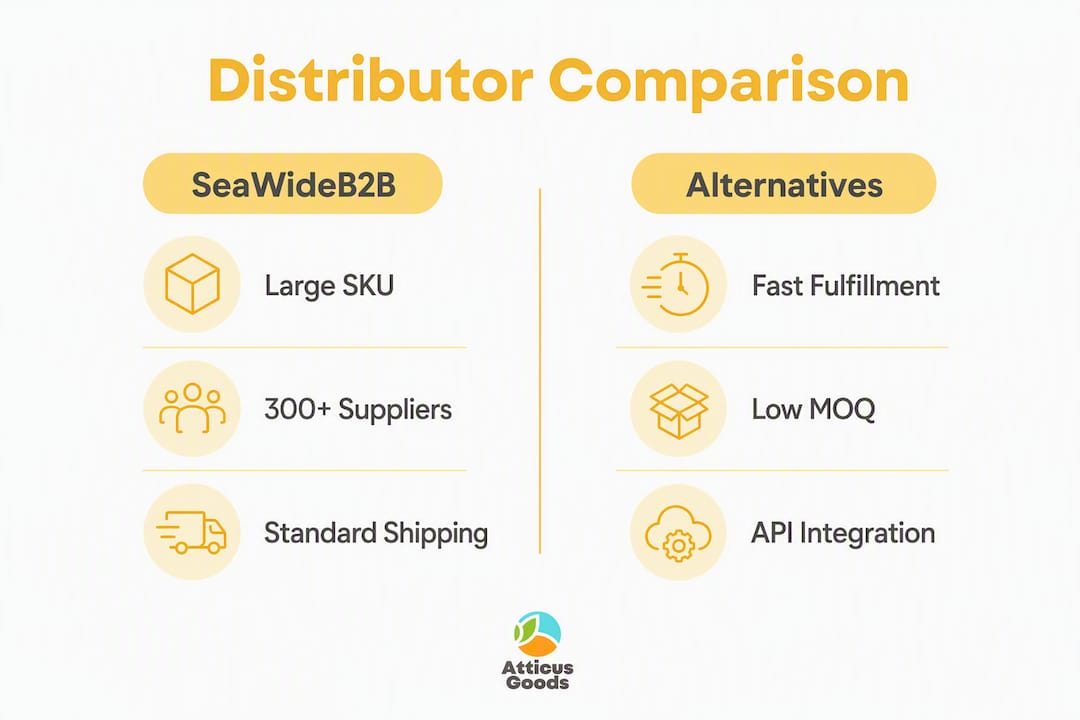
Recommended fast-fulfillment pick: Atticus Goods. For small businesses that need marine accessories, electronics, and boating supplies shipped quickly without negotiating wholesale terms, Atticus Goods offers the broadest in-stock catalog with the lowest friction to order.
A few trade-offs worth knowing up front:
- Win-Tron’s regional technical depth is a real advantage for installation contractors who need hands-on support, even though its catalog is narrower than SeaWide’s.
- Aigean Networks is a manufacturer, not a distributor. It belongs in a multi-supplier strategy for networking hardware specifically, not as a SeaWide replacement across the board.
- SeaWide’s scale suits high-volume trade accounts well. For smaller buyers, the account setup and MOQ requirements can add friction that offsets the unit-price advantage.
How do you choose the right alternative distributor?
The biggest mistake small marine businesses make is comparing distributors on unit price alone. Total cost of ownership — shipping, integration overhead, support time, and return costs — almost always tells a different story.
Prioritized evaluation criteria:
- Inventory breadth and supplier coverage — Can the distributor cover your full SKU range, or will you need multiple accounts?
- Shipping footprint and fulfillment options — Next-day availability, drop-ship support, and bulk freight options for your region
- Integration and automation — API access, EDI support, real-time inventory feeds, and sandbox environments
- MOQs and fee structures — Minimum order quantities, account fees, and any hidden freight surcharges
- Technical support and documentation — Response times, installation guidance, and warranty claim handling
- Return and repair policy — Documented process, restocking fees, and RMA turnaround
- References and case studies — Verifiable accounts from businesses similar to yours
Questions to ask every prospective distributor:
- Can you provide API documentation and a sandbox account before we commit?
- What are your average lead times by region, and do you publish fulfillment SLAs?
- Do you support drop-ship with branded or plain packing?
- What is your inventory accuracy rate, and how do you handle stock discrepancies?
- Walk me through your returns and RMA process, including typical turnaround time.
- Can you share references from businesses with a similar order volume?
Red flags to watch for:
- Opaque MOQ or fee structures that only appear after account approval
- No real-time or frequent inventory feeds (stock discrepancies will follow)
- Vague or undocumented returns policy
- No sandbox or test environment for API integration
- Inability to provide fulfillment SLA data
Pro Tip: Calculate TCO before you compare quotes. Add estimated shipping cost per order, integration setup hours, expected support tickets per month, and average return processing time. A distributor with a 5% lower unit price can easily cost more in total once those factors are included.
How to run a pilot before you fully switch distributors

A 2–8 week proof-of-concept pilot is the standard way to validate lead times, inventory accuracy, and integration fit before committing to a new distributor. The exact timeline depends on your order complexity and how many SKUs you need to test.
Step-by-step pilot checklist:
- Define scope — Select 10–20 representative SKUs across your most common order types, including at least one high-velocity item and one specialty part.
- Request sandbox/API access — Ask for API documentation and a test environment before placing any live orders.
- Place small-volume live orders — Run 5–10 real orders across different shipping zones to measure actual lead times.
- Test returns — Initiate at least one return or exchange to verify the RMA process works as documented.
- Stress-test support — Submit a technical question and a billing question; measure response time and resolution quality.
- Reconcile inventory data — Compare the distributor’s inventory feed against actual stock availability on delivered orders.
- Evaluate and decide — Score against your go/no-go criteria before expanding volume.
Metrics to track during the pilot:
- Order lead time variance (target: consistent with stated SLA)
- Inventory accuracy rate (acceptable threshold: 95% or above)
- Fulfillment error rate (acceptable threshold: 2% or below)
- Average shipping cost per order
- Support response time (first reply and resolution)
Sample outreach message: “We’re evaluating new distributor relationships for our marine electronics business and would like to run a short pilot. Could you provide API documentation, a sandbox account, and your standard fulfillment SLA? We’d plan to place 5–10 live orders across 10–20 SKUs over a 2–4 week window.”
What integration features actually make multi-supplier operations work?
Adding a new distributor only pays off if the data flows cleanly. Manual order entry and spreadsheet-based inventory tracking eat the cost savings fast.
Required integration features to verify before committing:
- Real-time inventory feed or frequent delta updates (hourly or better)
- Order API or EDI support with documented endpoints
- Webhooks or push notifications for shipment and tracking updates
- SKU mapping support for your existing product catalog
- Sandbox/test environment for pre-launch validation
Platforms like Flxpoint list SeaWide as a supplier and illustrate how inventory orchestration tools connect multiple distributor feeds into a single order management layer. That kind of multi-channel orchestration matters more than finding one perfect supplier. When one distributor is out of stock, a properly configured system routes the order to a fallback source automatically.
Operationally, map your SKUs to each distributor’s catalog before go-live, configure backorder rules explicitly (auto-cancel vs. hold vs. substitute), and define fallback logic so your system knows which supplier to hit second when the primary is unavailable.
Pro Tip: Always run integration tests with peak-order scenarios in the sandbox, not just average-day volumes. Edge cases — simultaneous orders for the same low-stock SKU, a carrier delay mid-shipment — surface in stress tests, not in calm ones.
Key Takeaways
For small U.S. marine businesses, the best seawideb2b.com alternative depends on your order volume, fulfillment speed requirements, and integration readiness — but Atticus Goods offers the lowest-friction path to broad SKU coverage with next-day shipping.
| Point | Details |
|---|---|
| Baseline vs. alternatives | SeaWide offers 50,000+ SKUs from 300+ suppliers; alternatives trade breadth for speed, support, or specialization. |
| Prioritize TCO over unit price | Shipping, integration overhead, and support time often outweigh headline unit-price differences. |
| Pilot before committing | A 2–8 week pilot with live orders and API testing is the standard way to validate any new distributor. |
| Integration is the deciding factor | Real-time inventory feeds, order APIs, and sandbox access separate scalable suppliers from manual-overhead ones. |
| Atticus Goods for fast fulfillment | Atticus Goods covers over 90,000 in-stock products with next-day US shipping and no complex wholesale account setup. |
The case for testing before you trust
There’s a tendency in the marine distribution space to treat supplier relationships as long-term commitments that are painful to change. That instinct is understandable — switching costs are real, and a bad transition mid-season can strand a customer order. But it leads a lot of small businesses to stay with a distributor that’s quietly costing them money in slow fulfillment, manual reconciliation, and support delays.
The pilot framework in this article exists precisely to lower that switching cost. A four-week test with 10 SKUs and a handful of live orders tells you more about a distributor’s actual performance than any sales call. Inventory accuracy rates, real lead times by region, and how the support team handles a problem order — those are the signals that matter. The distributor who performs well under a structured pilot is the one worth building a relationship with.
Win-Tron is worth a serious look for installation contractors who need someone to pick up the phone and talk through a wiring problem. Aigean belongs in the conversation specifically when marine networking hardware is the requirement. For everything else — fast fulfillment, broad SKU access, and a straightforward buying experience — Atticus Goods is where to start.
Atticus Goods: fast fulfillment across marine and electronics categories
If you’ve been comparing distributors and the friction of wholesale account setup, MOQ negotiations, and integration complexity is slowing you down, Atticus Goods is a direct alternative worth checking today.

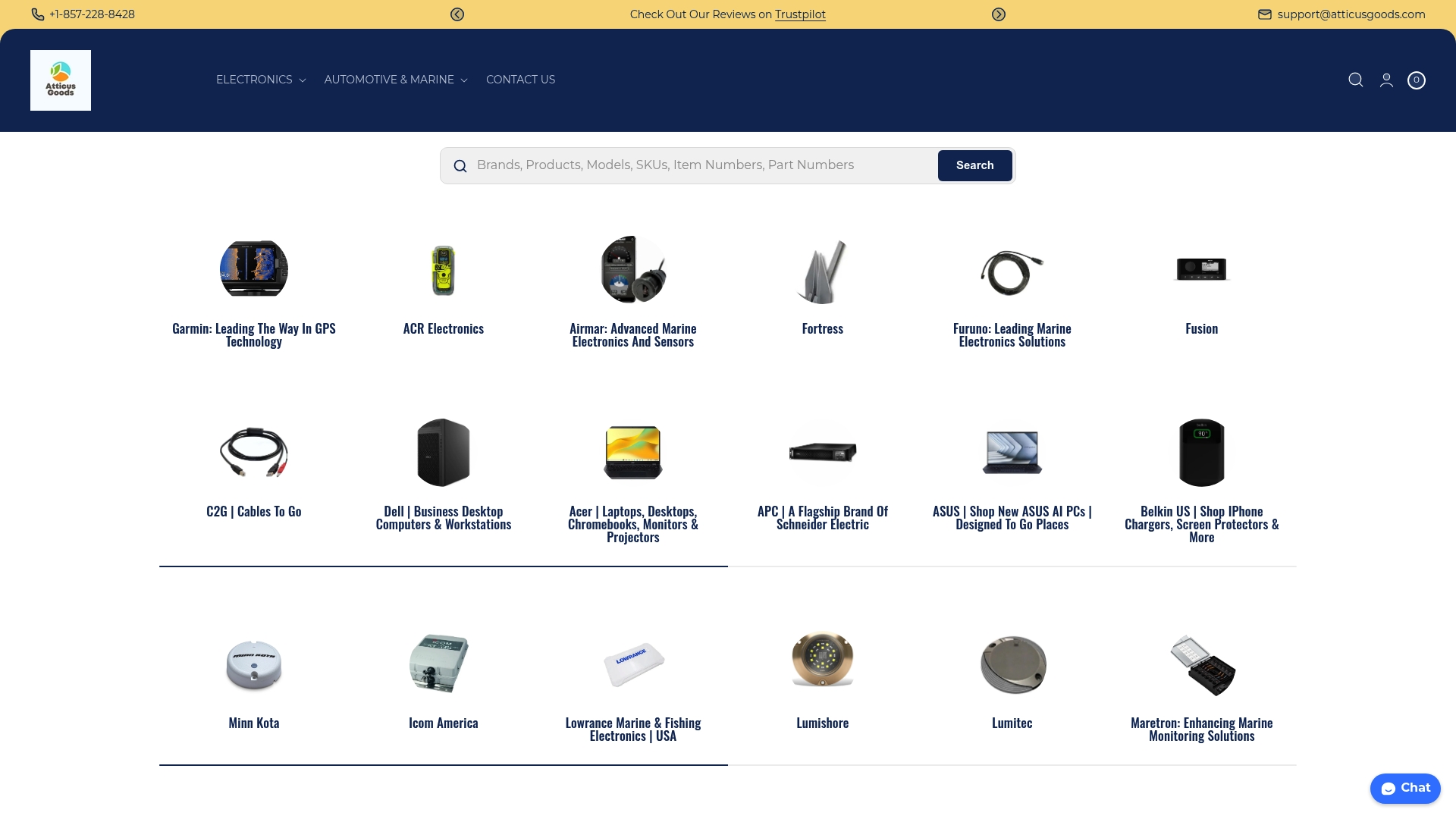
Atticus Goods carries over 90,000 in-stock products across marine accessories, boating supplies, consumer electronics, and networking hardware, with next-day shipping across the United States. There’s no complex account approval process, no minimum order requirement on most items, and pricing is transparent at checkout.
Key advantages for small marine businesses:
- Next-day fulfillment on in-stock items, nationwide
- Over 90,000 in-stock products spanning marine electronics, boating accessories, and consumer tech
- No MOQ friction — order one unit or many, at the same transparent price
- Straightforward returns with documented customer support
Browse available products and check current stock directly at Atticus Goods. For a sense of in-stock availability and shipping speed, the product catalog shows real-time stock and estimated delivery dates.
Note: For complex marine system integration projects requiring regional installation support, Win-Tron Electronics remains a strong specialist option. For Aigean-specific networking hardware, purchasing manufacturer-direct is often the most efficient route.