

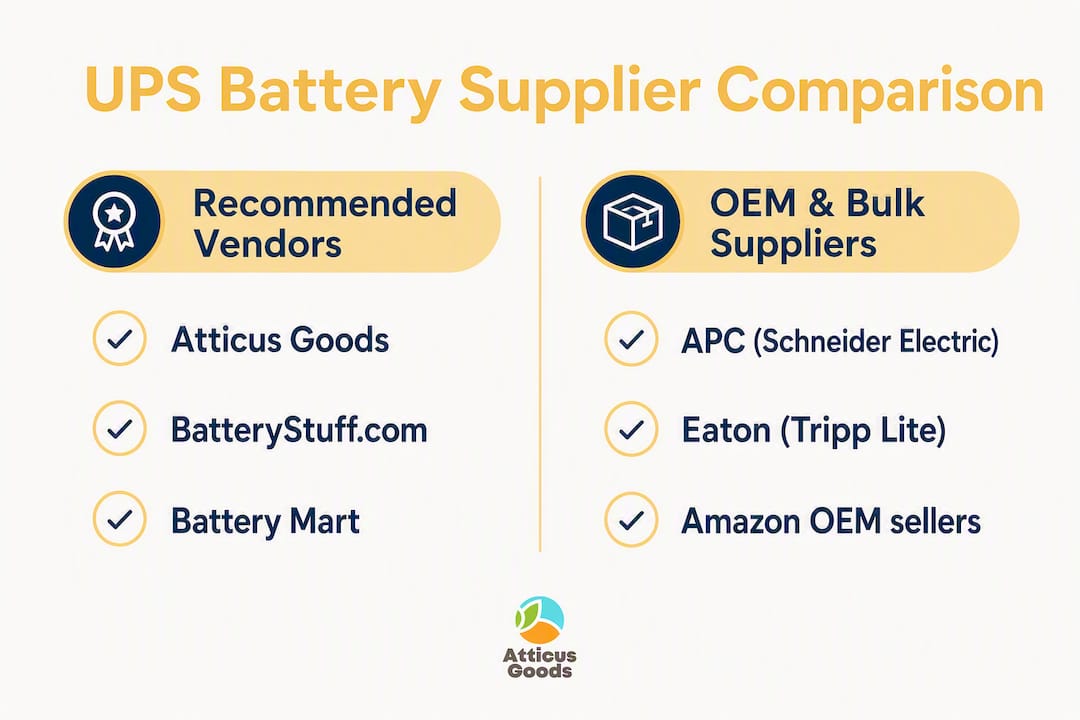
For U.S. buyers searching for upsplusbattery.ca alternatives, the most practical first stop is Atticus Goods, which carries in-stock UPS battery replacements with next-day shipping to many U.S. ZIP codes and model-matching support. Other reliable options include Batteries Plus (Bulbs), BatteryStuff.com, Battery Mart, Amazon (for OEM cartridges from APC/Schneider Electric and Eaton), and direct OEM channels from APC and Eaton themselves.
Here is the shortlist at a glance:
- Atticus Goods — broad in-stock inventory, next-day U.S. shipping, model-matching help, clear returns
- Batteries Plus (Bulbs) — walk-in and online, wide VRLA selection, in-store recycling
- BatteryStuff.com — aftermarket-specialist focus, strong datasheet library, phone support
- Battery Mart — value-priced compatible packs, good for budget-conscious home UPS owners
- Amazon — fast Prime shipping on OEM APC and Eaton cartridges; verify seller carefully
- APC (Schneider Electric) / Eaton direct — OEM cartridges with full manufacturer warranty
Before you order from any of these, check three things immediately: a downloadable datasheet for the exact model, a visible UL certification (UL 1973 or UL 9540A for lithium packs), and a written return or RMA policy. Those three signals separate trustworthy vendors from the ones that will cost you twice.
Table of Contents
- Which UPS battery suppliers are worth comparing side by side?
- How do you pick the right vendor and replacement battery?
- What do battery chemistry and compatibility actually mean for a UPS swap?
- What do replacement UPS batteries typically cost, and how long do they last?
- Short profiles of the shortlisted vendors and when to pick each
- Which option should you buy first?
- How should you handle UPS battery recycling and disposal?
- Key Takeaways
- The part most buyers skip until it costs them
- Atticus Goods carries in-stock UPS batteries with next-day U.S. shipping
- Sources and further reading
Which UPS battery suppliers are worth comparing side by side?
| Supplier | Best for | Product selection | Price band (per cartridge) | U.S. availability & shipping | Warranty / returns | Certifications / datasheets | Compatibility support |
|---|---|---|---|---|---|---|---|
| Atticus Goods | Fast in-stock replacements, home & small business | Compatible + OEM cartridges | $$ | Next-day to many ZIPs | Clear return policy | Datasheets available | Model-matching support |
| Batteries Plus (Bulbs) | Walk-in buyers, VRLA replacements | OEM + compatible VRLA | $–$$ | Same-day in-store; 2–3 days online | Store-level returns | UL-listed products | In-store fit check |
| BatteryStuff.com | Aftermarket specialists, tech-savvy buyers | Compatible VRLA + some lithium | $–$$ | Standard ground; 3–5 days | 30-day return window | Strong datasheet library | Phone/chat tech support |
| Battery Mart | Budget home UPS owners | Compatible VRLA | $ | Standard ground; 3–5 days | Standard return policy | Basic datasheets | Limited model lookup |
| Amazon | OEM cartridges, Prime speed | OEM APC, Eaton, Yuasa, CSB | $–$$$ | Prime 1–2 days | Seller-dependent | Varies by listing | None (self-service) |
| APC / Schneider Electric direct | OEM warranty, enterprise buyers | OEM cartridges only | $$–$$$ | 3–7 business days | Manufacturer warranty | Full datasheets + UL | Model-number lookup tool |
| Eaton (incl. Tripp Lite / Powerware) | OEM warranty, rack UPS buyers | OEM cartridges + modules | $$–$$$ | 3–7 business days | Manufacturer warranty | Full datasheets + UL | Model-number lookup tool |
Atticus Goods is the recommended first stop for most home and small-business buyers. In-stock inventory, next-day shipping, and a team that can confirm fit by UPS model number make it the lowest-friction path to a verified replacement.
Batteries Plus (Bulbs) earns its place for buyers who want to walk in, hand over the old battery, and leave with a replacement the same afternoon. The in-store recycling program is a practical bonus.
BatteryStuff.com is the pick for buyers who want to dig into specs before committing. Their datasheet library is one of the more thorough you will find among aftermarket specialists, and phone support is genuinely useful when you are unsure whether a compatible pack meets your UPS’s high-rate discharge requirement.
Battery Mart suits the buyer replacing a single home UPS on a tight budget. Selection is narrower and compatibility tools are basic, so have your exact model number ready.
Amazon moves fast, but the quality of a listing depends entirely on the seller. Stick to OEM cartridges sold directly by APC or Eaton, and read the seller ratings before you click buy.
APC (Schneider Electric) and Eaton (including the Tripp Lite and Powerware families) are the right call when your warranty requires OEM parts or when you are managing a rack environment where a non-OEM cartridge could void firmware-level battery management. Expect longer lead times and higher per-cartridge prices.

Pro Tip: When comparing compatible aftermarket packs against OEM cartridges, ask the vendor for the C-rating and cycle-life spec from the datasheet, not just the amp-hour (Ah) figure. A higher Ah number on a general-purpose cell can still underperform an OEM high-rate (HR) design under UPS load conditions.
How do you pick the right vendor and replacement battery?
A systematic check takes about ten minutes and prevents most bad purchases.
Step-by-step vendor checklist:
- Confirm model compatibility. Give the vendor your exact UPS model number (e.g., APC SMT1500RM2U) and ask them to confirm the replacement fits, not just the voltage and Ah rating.
- Request the datasheet. A legitimate vendor links or emails a PDF datasheet for the specific battery SKU. If they cannot produce one, stop.
- Check UL certification. For VRLA packs, look for UL 1989. For any lithium (LiFePO4) option, require UL 1973 and UL 9540A before buying.
- Read the warranty terms in full. Note whether the warranty covers the battery alone or the UPS as well, and whether using a compatible pack voids the UPS manufacturer’s coverage.
- Understand the return and RMA process. Ask: Is there a restocking fee? Who pays return shipping? How long does a refund take? Get this in writing before you order.
- Ask about HAZMAT shipping. Lead-acid batteries ship as hazardous materials. Confirm the vendor handles DOT-compliant packaging and that ground shipping is available to your ZIP code.
- Check lead time. In-stock items typically ship same or next day. Specialty lithium modules or high-capacity external packs can take one to three weeks, especially as supply dynamics shift for high-capacity lithium solutions.
Red flags to walk away from:
- No downloadable datasheet for the specific SKU
- Lithium pack with no UL 1973 or UL 9540A listing
- Return policy buried in fine print or absent entirely
- No way to confirm fit by UPS model number
- Unusually low price with no brand or certification information
Questions to copy and paste when contacting a vendor:
That single message filters out most vendors who cannot support a proper sale.
What do battery chemistry and compatibility actually mean for a UPS swap?
VRLA (valve-regulated lead-acid) is still the default for most home and office UPSes in the 650–1500 VA range. It is cheaper upfront, widely available, and drop-in compatible with the vast majority of existing UPS cartridge slots. LiFePO4 (lithium iron phosphate) is preferable when longer service life, a smaller physical footprint, and faster recharge are priorities, typically in higher-capacity or enterprise deployments.
The chemistry choice is only half the equation. UPS topology matters just as much.
Line-interactive UPSes (the most common type in home offices and small businesses) regulate voltage with an autotransformer and switch to battery only during outages. They work well with standard VRLA cartridges. Online double-conversion UPSes run the load through the inverter continuously, which means the battery is always in the discharge/recharge cycle. That topology benefits more from LiFePO4’s faster recharge and longer cycle life. For a deeper look at how topology affects your selection, the online double-conversion explainer at Atticus Goods walks through the practical differences.
One detail most buyers miss: UPS batteries are high-rate (HR) discharge designs, not general-purpose cyclic batteries. A standard deep-cycle battery with the same voltage and Ah rating will often fail early or overheat under the short, intense discharge bursts a UPS demands. Always verify the replacement is specifically rated for UPS high-rate applications.
Certifications to check before buying:
- UL 1973 — the standard for battery systems used in stationary energy storage (required for lithium packs)
- UL 9540A — thermal runaway propagation testing for lithium energy storage systems
- UL 1989 — the standard specifically for standby batteries (VRLA)
Schneider Electric’s UPS buying guide recommends VRLA for typical home/office applications and lithium-ion for higher-capacity enterprise deployments, citing longer design life and higher energy density as the deciding factors. As Riello’s battery guidance puts it, there is no single best battery — the right choice depends on site load, ambient temperature, and total cost of ownership.
Pro Tip: Pull the datasheet and look for two numbers: the C-rate (how fast the battery can discharge relative to its capacity) and the cycle-life figure at the stated depth of discharge. These two metrics predict long-term performance far better than the nominal Ah rating alone.
What do replacement UPS batteries typically cost, and how long do they last?
| Battery type | Typical price range per cartridge | Expected service life | Notes |
|---|---|---|---|
| VRLA (lead-acid), home UPS | $10–$30 | 2–5 years | Widely available; price scales with Ah capacity |
| VRLA, small-business rack UPS | $10–$30 | 2–5 years | Multi-cartridge units multiply cost |
| LiFePO4 module, small business | — | 8–10 years | Higher upfront; lower replacement frequency |
| OEM cartridge (APC/Eaton) | — | Matches OEM spec | Preserves manufacturer warranty |
Schneider Electric’s guidance puts VRLA replacement intervals at typically every 2–5 years, while LiFePO4 designs often reach 8–10 years of service life. The gap in replacement frequency is where LiFePO4’s higher upfront cost starts to look more reasonable over a five-year horizon, particularly for rack UPSes that hold multiple cartridges.
CyberPower’s technical data shows lithium recharges in 1–2 hours versus 8–16 hours for VRLA. For a business running an online double-conversion UPS, that recharge gap directly affects how quickly the system returns to full protection after an outage.
Factors that shorten VRLA life faster than the spec suggests:
- Ambient temperatures above 77°F (25°C) accelerate degradation
- Frequent partial discharges without full recharge cycles
- Overcharging from a faulty UPS charger circuit
- Storage in discharged state for more than a few weeks
On shipping costs: lead-acid batteries ship as DOT hazardous materials, which adds a surcharge to ground orders. Expect $10–$30 in HAZMAT handling fees depending on the vendor and battery size. Lithium packs carry their own shipping restrictions; some carriers require ground-only transport for larger lithium modules, which can push lead times to one to two weeks for specialty configurations. For more on how long a UPS battery lasts under real-world conditions, Atticus Goods has a practical breakdown that factors in temperature and usage patterns.
Short profiles of the shortlisted vendors and when to pick each
Atticus Goods stocks a broad range of UPS battery replacements alongside the UPS units themselves, which means you can confirm fit across both the battery and the host system in one place. Next-day shipping reaches a large portion of U.S. ZIP codes, and the support team can verify compatibility by model number before you order. Best choice when you want a fast, verified replacement without the back-and-forth.
Batteries Plus (Bulbs) operates hundreds of retail locations across the U.S. alongside its online store. The VRLA selection covers most major home and small-business UPS brands, and in-store staff can often test your old battery on the spot. Pick this vendor when same-day pickup matters more than price, or when you want to hand off the dead battery for recycling at the same time.
- Walk-in availability: strong in most metro areas
- Online ordering: 2–3 day standard shipping
- Recycling: in-store drop-off at no charge
BatteryStuff.com is built around aftermarket-compatible packs and has one of the more thorough datasheet libraries among non-OEM specialists. Phone support is a genuine differentiator here — their team can walk through high-rate discharge specs and confirm whether a compatible pack meets your UPS’s requirements. Lead times run 3–5 business days for most VRLA orders.
Battery Mart keeps prices low on compatible VRLA packs for common home UPS models. The trade-off is a narrower catalog and less robust compatibility tooling. Have your exact model number and the battery’s dimensions ready; do not rely on the site’s lookup tool alone for less common UPS units.
Amazon is fast, but the quality of the experience depends entirely on who is selling. OEM cartridges sold directly by APC or Eaton through Amazon are reliable. Third-party listings for compatible packs vary widely in certification status. Always check the seller name, not just the listing, and confirm the product page links to a real datasheet.
APC (Schneider Electric) and Eaton (Tripp Lite / Powerware) sell OEM cartridges directly through their own portals. These are the right call when your UPS uses proprietary firmware-managed battery trays, when the manufacturer warranty requires OEM parts, or when you are standardizing across multiple sites. As Xtreme Power Conversion notes, platform-level topology standardization across multi-site deployments should drive battery chemistry selection, not the other way around.
Pro Tip: If you manage more than three UPS units across a small-business environment, check whether your UPS brand offers a battery replacement program or volume pricing through its direct channel. The per-cartridge savings on a five-unit order can offset the OEM price premium.
Battery brands worth knowing: CSB Battery, Panasonic, Yuasa, and Leoch are the VRLA cell manufacturers behind many OEM and compatible cartridges. CSB and Yuasa in particular appear in OEM-spec replacements for APC and Eaton units. Leoch and Panasonic supply both OEM and aftermarket channels. When a vendor lists a compatible pack, ask which cell brand is inside — a CSB or Yuasa cell in a compatible housing is a meaningfully different product than an unbranded cell.
Which option should you buy first?
The right answer depends on what you are optimizing for.
For fast in-stock delivery and model-matching help: Start with Atticus Goods. In-stock inventory, next-day shipping to most U.S. addresses, and support staff who can confirm fit by UPS model number make it the lowest-friction path to a verified replacement battery.
- Lowest upfront cost: Battery Mart or BatteryStuff.com for compatible VRLA packs on common home UPS models
- Longest service life / LiFePO4 adoption: APC or Eaton direct for OEM lithium modules, or BatteryStuff.com for compatible lithium options with verified datasheets
- OEM warranty preservation: APC (Schneider Electric) or Eaton direct channels only
One caveat worth stating plainly: for large enterprise deployments where you are standardizing dozens of UPS units across multiple sites, manufacturer-certified lithium modules and site-level topology planning matter more than single-cartridge price. In that scenario, go directly to Eaton or APC and ask about their enterprise battery replacement programs. For everyone else — home office, small business, a handful of rack units — Atticus Goods covers the practical middle ground well.
How should you handle UPS battery recycling and disposal?
Lead-acid batteries are among the most recycled products in the U.S., with the industry maintaining a high recovery rate through established collection networks. That does not mean you can put them in the trash. VRLA batteries contain sulfuric acid and lead, both of which are regulated under EPA and state hazardous waste rules.
Practical recycling options:
- Batteries Plus (Bulbs): in-store drop-off at no charge, available at most locations
- AutoZone, O’Reilly Auto Parts, and similar retailers: accept sealed lead-acid batteries for recycling at the counter
- EPA’s hazardous waste locator (search “battery recycling near me” on earth911.com): finds certified drop-off points by ZIP code
- Your UPS vendor: some vendors, including APC and Eaton, offer take-back programs for OEM cartridges returned during a replacement order
LiFePO4 batteries require separate handling. They are not accepted at standard lead-acid recycling points. Contact the battery manufacturer or a certified lithium battery recycler — Call2Recycle operates a U.S. network that accepts lithium chemistries. Never ship a damaged or swollen lithium battery without consulting the carrier’s HAZMAT guidelines first.
Before disposal, tape the terminals of any battery (lead-acid or lithium) to prevent short circuits during transport. Most recyclers and drop-off locations expect this as a basic safety step.
Key Takeaways
The single most important step before ordering any UPS replacement battery is confirming model compatibility and requesting a datasheet — skipping either one is how buyers end up with a battery that fits the slot but fails under load.
| Point | Details |
|---|---|
| Model match first | Always give the vendor your exact UPS model number and get written confirmation of fit before ordering. |
| Datasheets and UL certs | Require a downloadable datasheet and verify UL 1989 (VRLA) or UL 1973 / UL 9540A (lithium) before buying. |
| VRLA vs LiFePO4 TCO | VRLA costs less upfront but needs replacement every 2–5 years; LiFePO4 lasts 8–10 years with faster recharge. |
| Shipping and HAZMAT | Lead-acid batteries ship as hazardous materials; budget $10–$30 in surcharges and confirm ground availability. |
| Atticus Goods | In-stock UPS batteries with next-day U.S. shipping and model-matching support make it a practical first stop. |
The part most buyers skip until it costs them
Most of the frustration I see in UPS battery purchases comes from one skipped step: buyers confirm voltage and Ah rating, assume that is enough, and then discover the replacement either does not fit the cartridge tray or trips the UPS’s battery-management system. The model number check and the datasheet request are not bureaucratic extras. They are the two things that tell you whether a battery will actually work in your specific unit.
What makes Atticus Goods worth mentioning in that context is not just the inventory depth. It is that the support team can run the model-number check before you place the order, which cuts return friction dramatically. A return on a lead-acid battery is not like returning a phone case. There are HAZMAT considerations, restocking fees at some vendors, and a week or more of downtime while you wait for the right part. Getting the fit confirmed upfront is worth the extra two minutes.
Atticus Goods carries in-stock UPS batteries with next-day U.S. shipping
If you have been comparing suppliers and want to skip the back-and-forth, Atticus Goods stocks replacement UPS batteries across a broad range of capacities and form factors, with next-day shipping available to a large portion of U.S. addresses. The catalog covers compatible VRLA cartridges for the most common APC, Eaton, and Tripp Lite UPS models, alongside the UPS units themselves.
The practical next step: head to Atticus Goods and search by your UPS model number, or contact support directly with the model number and your runtime requirements. The team can confirm fit and point you to the right cartridge before you order, which means no HAZMAT return shipping and no waiting a second week for the correct part.
Sources and further reading
These are the primary sources behind the recommendations and technical claims in this article. Check the datasheets and UL certification links on any vendor’s product page before purchasing.
- UPS Buying Guide: Choose the Right Battery Backup | Schneider Electric United States — chemistry selection by application, VRLA vs lithium, topology guidance
- Lead-Acid or Lithium: Which UPS Battery Should You Choose? | CyberPower — recharge time comparison and operational readiness data
- Benefits of Lithium-Powered UPS | CyberPower — cycle life, footprint, and total cost of ownership for LiFePO4
- Different Types of UPS Batteries | Riello UPS — practitioner perspective on context-based battery selection
- P91 Li-UPS Comparisons | Xtreme Power Conversion — topology standardization and high-rate discharge requirements
- UPS Battery Market Report | Mordor Intelligence — supply dynamics, market concentration, and lead-time considerations
- Online Double-Conversion UPS Explained | Atticus Goods — how topology affects battery selection
- How Long Does a UPS Battery Last? | Atticus Goods — real-world lifespan factors including temperature and usage patterns
Verify UL listings directly on the UL Product iQ database using the certification number printed on the battery label or listed in the vendor’s datasheet.