

The Standard Horizon HX890E is the best handheld VHF radio for most boaters, thanks to its balance of transmit power, waterproofing, and GPS/DSC readiness. If you need AIS situational awareness and the loudest audio on the water, the Icom IC‑M94DE is the better pick. Budget shoppers should look at the Uniden Atlantis 155 or Standard Horizon HX40E, and the full comparison table below breaks down every spec that matters.
TL;DR:
- Handheld VHF radios are best used as backup devices, with most models offering a range of 3 to 8 nautical miles depending on antenna height.
- Waterproof ratings significantly impact durability; IPX8 models like the Uniden MHS338BT can endure deeper or longer submersion than IPX7 units.
- Features like DSC with GPS are crucial for safety, but waterproofing and flotation should take priority based on the likelihood of dropping gear overboard.
- The Standard Horizon HX890E is the top overall choice for reliability and full features, while the Icom IC‑M94DE excels in AIS and audio performance.
- Availability and replacement parts are readily accessible through major online retailers like Atticus Goods, with next-day shipping to prevent delays.
Table of Contents
- What Are the Best Handheld VHF Radios for Boating?
- How Do the Featured Handheld VHF Radios Compare?
- How Should You Choose the Right Handheld VHF Radio?
- How Did We Test and Verify These VHF Radios?
- Who’s Behind This Guide and Why It’s Trustworthy
- What Actually Matters When You’re Choosing a Handheld VHF
- Where to Buy These Handheld VHF Radios Fast
- Sources
- FAQ
What Are the Best Handheld VHF Radios for Boating?
Not every boat needs the same radio. A weekend kayaker doesn’t need AIS, and an offshore cruiser shouldn’t settle for a 3-watt toy. The shortlist below reflects that split, ranked by how well each model handles the job it’s built for rather than by price alone.
- Standard Horizon HX890E — Best overall handheld, with a full feature set and reliable waterproofing and ergonomics.
- Icom IC‑M94DE — Best for AIS and audio; the only handheld here with an integrated AIS receiver.
- Uniden MHS338BT — Best for GPS/DSC plus Bluetooth in one floating, IPX8-rated body.
- Icom IC‑M25Euro — Best battery life; roughly 14 hours in Eco Mode.
- Uniden Atlantis 155 — Best budget backup for casual boaters and paddlers.
- Standard Horizon HX210 — Best floating handheld with a water-activated strobe for recovery.
- Cobra HH600 DSC — Best for phone-connect features paired with DSC distress calling.
- Standard Horizon HX40E — Best compact pick for tenders and paddlecraft.
| Model | Transmit Power (W) | Waterproof/Float | GPS/DSC/AIS | Battery Life | Standout Feature | Best For |
|---|---|---|---|---|---|---|
| Standard Horizon HX890E | 6 W | Floats, high water rating | DSC, GPS-ready | Several hours, standard use | Full feature set, proven ergonomics | Most boaters wanting a full-featured backup |
| Icom IC‑M94DE | 6 W | IPX7 | Integrated AIS, DSC | ~10 hours | Integrated AIS receiver, 1500 mW speaker | Boaters wanting AIS situational awareness |
| Uniden MHS338BT | Up to 6 W | IPX8/JIS8, floats | GPS, DSC, Bluetooth | Rated for extended use | GPS + DSC + Bluetooth combo | Coastal cruisers wanting GPS/DSC and calling |
| Icom IC‑M25Euro | 2.5–5 W | IPX7, floats | Basic | ~14 hours in Eco Mode | Long battery life, Float’n Flash | Day sailors on longer outings |
| Uniden Atlantis 155 | Lower power | Adequate waterproofing | None | Standard | Value pricing | Casual boaters and paddlers |
| Standard Horizon HX210 | 6 W | Floats | Basic | Standard | Water-activated strobe | Small-boat recovery scenarios |
| Cobra HH600 DSC | Mid-power | Standard | DSC | Standard | Phone connectivity | DSC users wanting phone integration |
| Standard Horizon HX40E | Lower power | Floats | None | Standard | Compact size | Tenders and paddlecraft |
Waterproof ratings matter more than most buyers realize. An IPX7 unit can survive a dunk to about a meter for 30 minutes, while IPX8 models like the MHS338BT are built for deeper or longer submersion. If you’re prone to dropping gear overboard, that difference is worth paying for.
How Do the Featured Handheld VHF Radios Compare?
Every model below is currently available to US buyers, and each one earns its spot on this list for a specific reason rather than a generic “good all-rounder” label.
Standard Horizon HX890E. This is the flagship most boaters should default to. It runs 6 W transmit, floats, and pairs solid ergonomics with a proven track record in rough conditions. Pros: full feature set, reliable build. Con: pricier than basic models.
Standard Horizon HX210. A workhorse 6 W floating handheld with a water-activated strobe, built for the moment it goes overboard. Pros: floats and flashes automatically, simple controls. Con: no AIS or advanced GPS features.
Standard Horizon HX40E. The compact choice for dinghies, kayaks, and tenders. It floats and fits in a small dry bag without weighing down the gear list. Pros: small footprint, budget-friendly. Con: lower power ceiling than flagship models.
Icom M37E. Icom’s user-friendly midrange handheld, built around clear audio and simple operation rather than a long feature checklist. Pros: strong audio clarity, comfortable grip. Con: fewer advanced features than the M94DE.
Icom IC‑M25Euro. The battery-life champion here, offering roughly 14 hours in Eco Mode at 2.5 W, a real advantage on multi-day trips. It also floats and includes Float’n Flash recovery lighting. Pros: exceptional endurance, IPX7 rating. Con: reduced range in Eco Mode.
Icom IC‑M94DE. The only handheld on this list with an integrated AIS receiver, plus 6 W transmit and about 10 hours of typical runtime. Its 1500 mW speaker is genuinely loud in wind. Pros: AIS awareness, best-in-class audio. Con: premium price tag.
Icom M73. A balanced option for buyers who want Icom’s reliability without paying flagship prices. Pros: solid value, dependable build. Con: lacks AIS.
Cobra MR HH500 FLT BT. Floating handheld with Bluetooth pairing for hands-free calling on the water. Pros: smartphone convenience, flotation. Con: Bluetooth range is limited compared to VHF range.
Cobra HH600 DSC. Combines DSC distress calling with phone-connect features. Pros: distress signaling plus connectivity. Con: mid-tier transmit power.
Cobra MR HH350. A straightforward handheld aimed at boaters who want core VHF function without extras. Pros: simple, dependable. Con: limited standout features.
Cobra BlueBound 150. An entry-level option for basic ship-to-ship and ship-to-shore communication. Pros: low cost. Con: minimal safety extras.
Uniden Atlantis 155. The value pick for casual boaters and paddlers who mainly need short-range backup coverage. Pros: low price, adequate waterproofing. Con: no GPS or DSC.
Uniden Atlantis 275. Steps up to 6 W transmit with a built-in strobe and flotation for recovery-focused buyers. Pros: strong power-to-price ratio. Con: bulkier than entry models.
Uniden MHS338BT. IPX8/JIS8-rated and floating, with integrated GPS, DSC, and Bluetooth calling at up to 6 W. This is the most connected handheld on the list. Pros: GPS/DSC/Bluetooth combo, rugged rating. Con: more buttons to learn than a basic unit.
Uniden MHS75. A simpler Uniden handheld for boaters who want dependable basic VHF coverage without the connected features. Pros: easy operation. Con: no advanced safety electronics.
How Should You Choose the Right Handheld VHF Radio?
Range is the first reality check. Handhelds typically transmit at 3 to 6 watts, with practical line-of-sight range in the 3 to 8 nautical mile window, because antenna height, not just power, drives distance. A fixed-mount 25 W unit mounted high on a mast can reach 15 to 25-plus nautical miles. That gap means a handheld works best as backup or tender radio rather than your only communications lifeline for serious offshore passages.
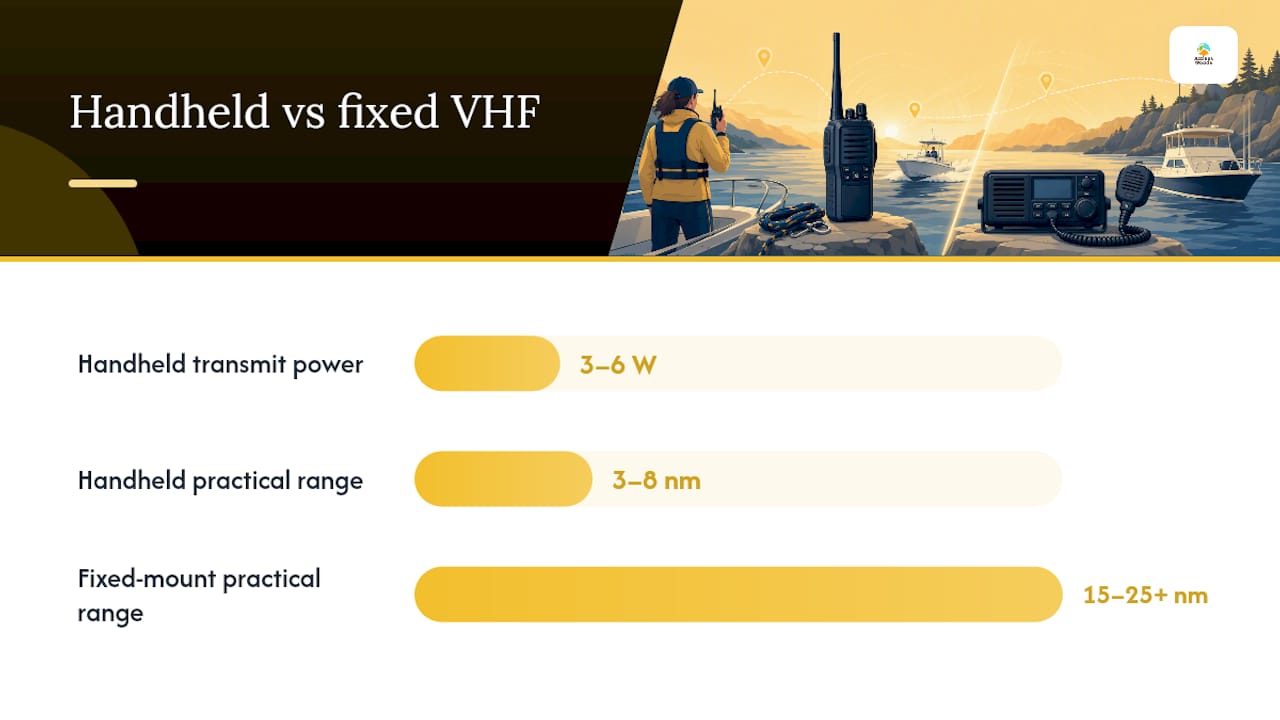
Waterproofing, DSC, GPS, and AIS should top your feature checklist, in that order for most recreational boaters. IPX7 protects against a one-meter dunk for 30 minutes; IPX8 units like the Uniden MHS338BT are rated for deeper or longer exposure. Digital Selective Calling (DSC) sends your boat’s position with one button press during an emergency, and pairing it with GPS means rescuers get exact coordinates instead of a garbled radio call.
Before buying, run through this checklist — and ensure you can get a replacement battery for your radio model when needed:
- Does the radio include DSC, and is it registered with an MMSI number?
- Can you get a spare battery or charging cradle easily?
- Does it receive NOAA weather channels?
- What’s the warranty length, and does the manufacturer sell replacement parts?
- Is the waterproof rating IPX7 or IPX8, and does that match how you actually use the boat?
Watch for red flags: vague battery specs with no stated hours, a waterproof rating that’s never mentioned outright, or a speaker with no loudness figure listed anywhere. Manufacturers who publish real numbers, like Icom’s 1500 mW speaker rating on the IC‑M94D, tend to be more trustworthy across the board.
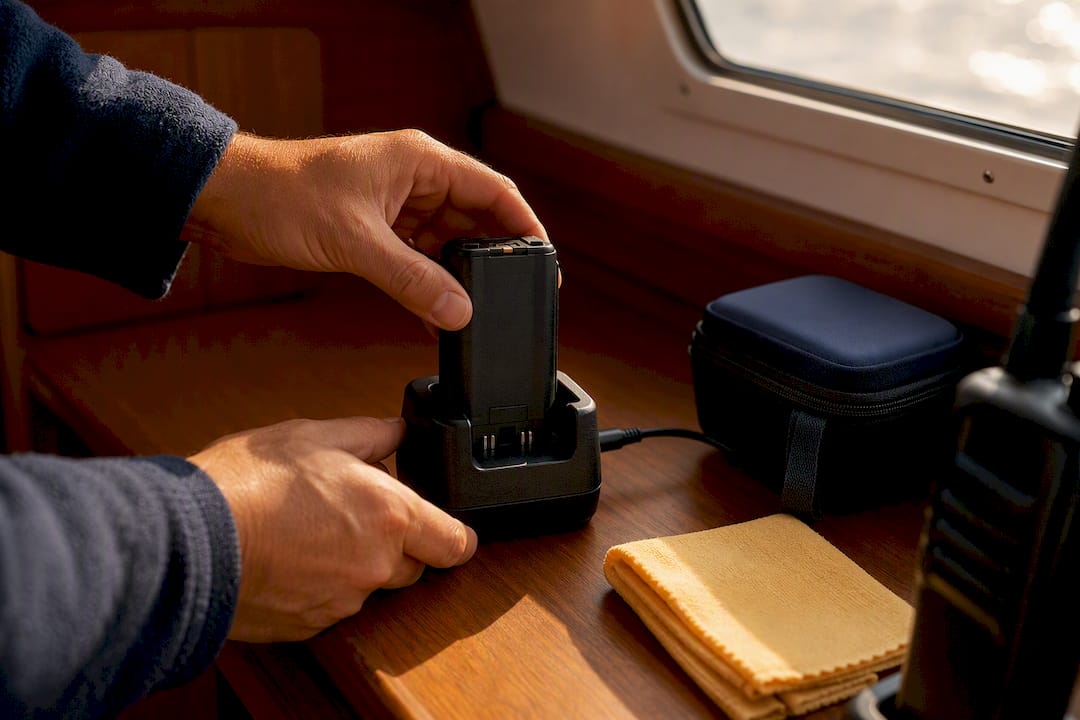
Pro Tip: Keep your handheld’s battery on a maintenance charge over winter storage. Li-ion packs degrade faster when left fully depleted for months, and a dead backup radio does you no good in an emergency.
How Did We Test and Verify These VHF Radios?
Evaluations for this roundup focused on real conditions: waterproofing and float behavior after submersion, DSC distress transmission reliability, audio clarity in wind and spray, GPS coordinate accuracy against known waypoints, and battery endurance in both standard and Eco power modes.
- Manufacturer spec sheets were cross-checked for battery hours and IP ratings, including Icom’s published Eco Mode figures.
- FCC maritime mobile guidance informed how we frame VHF’s role as primary safety communication on US waters.
- Author experience with marine electronics selection and troubleshooting shaped the buying criteria throughout this guide.
Who’s Behind This Guide and Why It’s Trustworthy
This roundup was written by Matthew Vista, drawing on marine electronics research and hands-on evaluation criteria rather than marketing copy alone. Atticus Goods backs the recommendations with a catalog spanning marine and boating electronics, fast nationwide shipping, and a customer review program that surfaces real buyer feedback. Readers can verify battery, waterproofing, and warranty details directly on each product page before buying.
What Actually Matters When You’re Choosing a Handheld VHF
Most buying guides treat handheld VHFs like commodity gadgets, ranking them by price and feature count. That misses the point. A handheld’s real job is being the thing that works when everything else fails, when the fixed-mount radio loses power, when you’re in the dinghy without the main console, or when you’ve gone overboard and need one working device on your life vest.
That reframes the priority list. Waterproof rating and flotation matter more than an extra button or a slightly louder speaker. DSC with GPS matters more than a sleek screen, because it turns a panicked mayday call into a coordinate the Coast Guard can act on instantly. AIS is genuinely valuable, but only if you’re the kind of boater who needs to see traffic before it sees you.
The conventional advice to “buy the one with the most features” is backwards. Buy the one that survives the scenario you’re most likely to face, and treat the handheld as a backup to a proper fixed-mount VHF setup, not a replacement for one.
— Matthew Vista
Where to Buy These Handheld VHF Radios Fast
Boaters benefit from next-day nationwide shipping on in-stock marine electronics, helping prevent delays due to failed handheld radios. Instead of hunting across multiple specialty sites for the right model, spare battery, or charging cradle, you get a single storefront covering marine electronics alongside the rest of your boating and outdoor gear.
Whichever model fits your boat, from the Standard Horizon HX890E to the Uniden MHS338BT, check the Atticus Goods marine and boating selection for current availability, replacement batteries, and charging accessories before you head out. Warranty terms and spare-parts availability are listed on each product page, and customer support is on hand if you run into setup questions after your radio arrives. If you hit trouble pairing DSC or Bluetooth features after installation, the troubleshooting guide for marine communication systems walks through common fixes. Start by browsing the current lineup and picking the model that matches the checklist above.
FAQ
What Is the Best Handheld VHF Radio for Boating?
The Standard Horizon HX890E is the best all-around pick for most boaters, combining 6 W transmit power, flotation, and dependable ergonomics. If you specifically need AIS traffic awareness, the Icom IC‑M94DE is the stronger choice.
Are Handheld VHF Radios Any Good?
Yes, handheld VHF radios are genuinely useful as backup or secondary communication, especially in emergencies when a fixed-mount radio fails or you’re away from the helm. They’re best treated as a complement to a fixed-mount setup rather than a full replacement, since handhelds typically reach only 3 to 8 nautical miles compared to 15 to 25-plus for a fixed-mount unit.
What Is the Best Handheld Radio on the Market Overall?
Among current handheld VHF models, the Standard Horizon HX890E and Icom IC‑M94DE lead the pack depending on your priorities: overall reliability versus AIS and audio performance. The Uniden MHS338BT is also a strong contender if you want GPS, DSC, and Bluetooth calling in one IPX8-rated floating body.
How Far Will a Handheld VHF Radio Transmit?
Most handheld VHF radios transmit at 3 to 6 watts and cover roughly 3 to 8 nautical miles under typical line-of-sight conditions. Range depends heavily on antenna height and terrain, so a handheld held at deck level will always underperform a fixed-mount antenna mounted higher on the boat.
Can I Find These Handheld VHF Radios at Atticus Goods?
A variety of marine electronics are available with nationwide next-day shipping on in-stock items. Current pricing and availability for specific handheld VHF models are listed directly on the Atticus Goods site.