

HDPE marine dock floats are defined as encapsulated flotation units that combine a high-density polyethylene outer shell with a solid expanded polystyrene foam core, delivering unsinkable buoyancy and superior resistance to the full range of marine environmental stressors. The reason to use HDPE marine dock floats is straightforward: they outlast every common alternative, require virtually no maintenance, and meet the environmental compliance standards that regulators increasingly require. Encapsulated HDPE floats achieve an industry-leading lifespan of 15 to 20-plus years, compared to 10–15 years for hollow plastic and just 3–7 years for bare EPS foam. That gap translates directly into lower total cost of ownership for both individual boaters and commercial marina operators.
Why use HDPE marine dock floats: construction and how they work
The engineering behind HDPE dock floats explains their performance advantage. The outer shell is formed through rotational molding, a process that produces a seamless, uniform wall with approximately 0.150 inches of nominal wall thickness. That thickness gives the shell the impact resistance needed to handle boat traffic, debris strikes, and wave action without fatigue cracking.
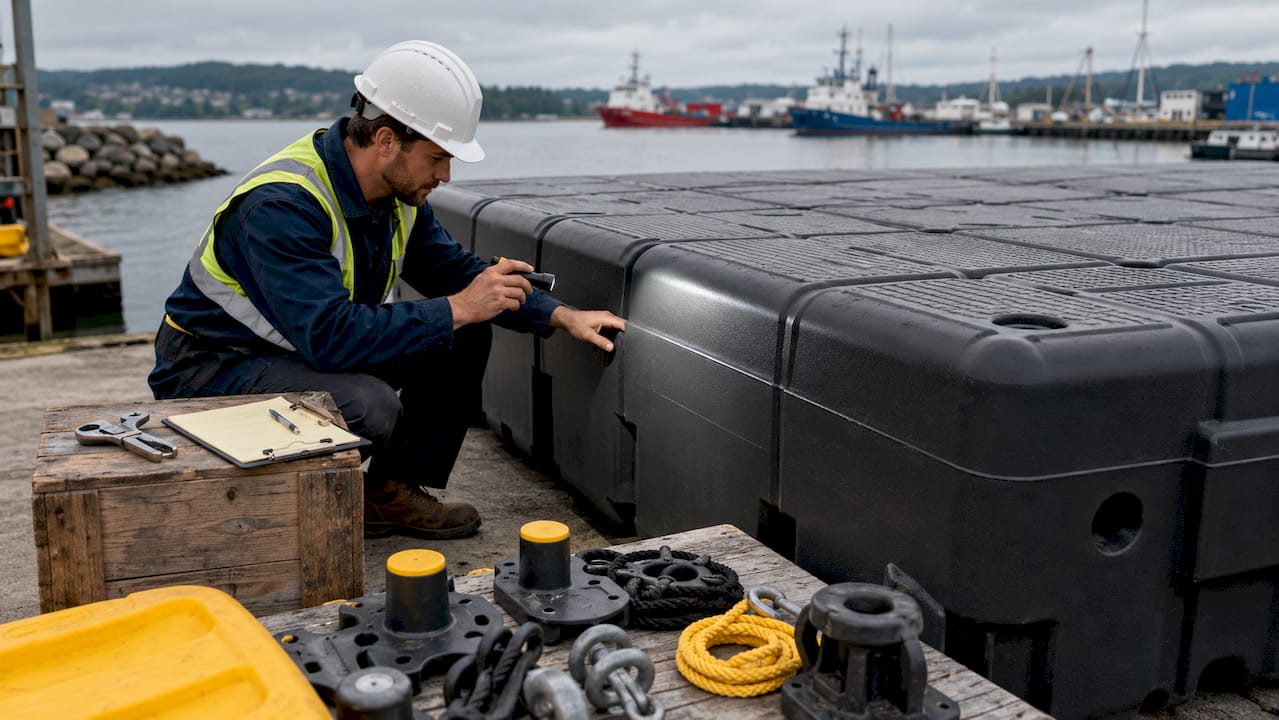
Inside the shell sits a solid EPS foam core. This core is the safety feature that separates encapsulated floats from hollow alternatives. Even if the shell is punctured, the foam core maintains buoyancy and prevents catastrophic sinking. A hollow float that loses its air pocket simply fails. An encapsulated float keeps your dock above water.
The HDPE shell also acts as a full barrier around the foam. It blocks water absorption, shields the core from UV degradation, and prevents burrowing animals from accessing and destroying the foam. This encapsulation is what makes the float genuinely maintenance-free over its service life.
- Impact resistance: The 0.150-inch wall handles repeated wave strikes and vessel contact without cracking.
- Unsinkable core: The EPS foam core provides buoyancy even after outer shell damage.
- Water barrier: The sealed shell stops water from reaching and saturating the foam.
- UV protection: HDPE naturally resists UV degradation, protecting both shell and core.
- Freeze-thaw resilience: HDPE flexes through freeze-thaw cycles without internal stress cracking.
Pro Tip: When inspecting a float before purchase, check that the shell is fully sealed with no seams or gaps. Any opening in the encapsulation defeats the water barrier and shortens the float’s service life significantly.
How do HDPE dock floats compare to other materials in lifespan?
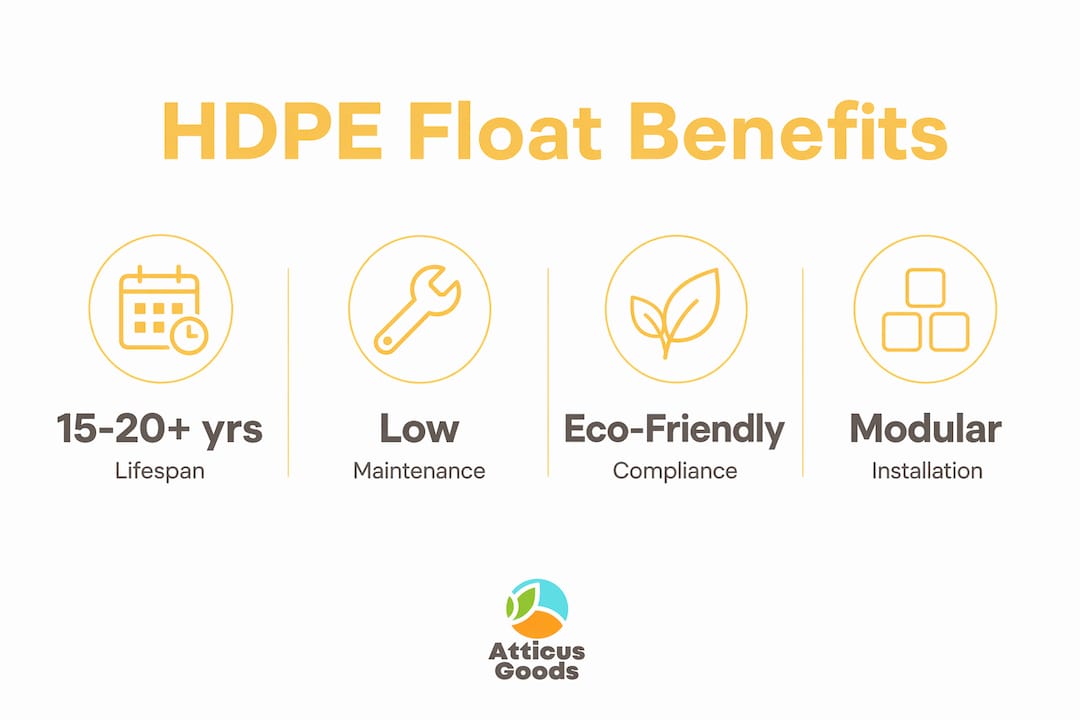
Lifespan is where the advantages of HDPE dock floats become undeniable. Encapsulated HDPE floats last 15 to 20-plus years. Hollow plastic floats typically reach 10–15 years before UV degradation and impact fatigue cause failure. Bare EPS foam floats last just 3–7 years, crumbling under UV exposure and physical contact. Wood docks require annual sealing, painting, and structural inspection, and still rot within a decade in wet environments. Steel docks corrode and demand anti-rust treatments every few years.
| Material | Typical lifespan | Key maintenance requirement |
|---|---|---|
| Encapsulated HDPE | 15–20+ years | None |
| Hollow plastic | 10–15 years | Periodic inspection and replacement |
| Bare EPS foam | 3–7 years | Frequent replacement |
| Wood | 5–10 years | Annual sealing, painting, structural repair |
| Steel | 10–15 years | Anti-corrosion treatment, rust removal |
HDPE floats eliminate painting, sealing, and anti-corrosion treatments entirely. That maintenance elimination is not a minor convenience. For a commercial marina managing dozens of dock sections, it removes thousands of dollars in annual labor and materials costs. For a residential boater, it removes the seasonal chore of dock preparation and end-of-season treatment.
The upfront cost of encapsulated HDPE floats is higher than bare foam or hollow plastic. That cost difference disappears quickly when you account for replacement cycles and maintenance spending. A bare foam float replaced every five years costs more over a 20-year period than a single HDPE float that requires no intervention. The lifecycle economics consistently favor HDPE for any dock expected to serve more than a few seasons.
HDPE also resists chemical exposure from fuel spills, bilge discharge, and saltwater. Wood absorbs these chemicals and degrades faster. Steel corrodes on contact with salt. HDPE remains chemically inert across all standard marine environments.
What environmental and regulatory benefits do HDPE floats offer?
Environmental compliance is now a primary driver of HDPE adoption in marine construction. The US Army Corps of Engineers favors encapsulated floats specifically because they prevent foam debris from entering waterways. Bare EPS foam breaks apart over time, releasing small particles that contaminate water and harm aquatic life. Encapsulated HDPE eliminates that risk entirely.
Encapsulated HDPE dock floats prevent foam particle pollution by keeping the EPS core fully sealed from the marine environment, making them the preferred choice under US Army Corps of Engineers guidelines for waterway protection.
The environmental benefits extend beyond debris prevention:
- No chemical leaching: HDPE is non-toxic and does not release harmful compounds into the water.
- Animal resistance: The hard shell prevents birds and rodents from burrowing into and fragmenting the foam core.
- Recyclable material: HDPE is a widely recycled plastic, reducing end-of-life environmental impact.
- Minimal ecosystem disruption: Modular HDPE dock systems can be installed and removed with minimal disturbance to the waterbed and surrounding habitat.
The regulatory trend is clear. Jurisdictions across the United States are moving toward requiring encapsulated floats for new dock permits. Choosing HDPE now positions both residential and commercial dock owners ahead of compliance requirements rather than scrambling to retrofit later.
How does the modular design speed up installation and improve performance?
Modular HDPE dock floats reduce installation time by up to 30% compared to traditional concrete dock construction. That reduction comes from the combination of lightweight components and interlocking connection systems that require no heavy equipment to assemble. A crew that would spend days pouring and curing concrete can complete an equivalent HDPE dock installation in a fraction of the time.
The modular design also gives dock owners flexibility that fixed materials cannot match. Individual float sections connect and disconnect without specialized tools. This means you can expand a dock as your needs grow, reconfigure the layout for different vessel types, or replace a single damaged section without rebuilding the entire structure. For small island communities and coastal installations, this adaptability has made modular HDPE the standard for connector docks.
Here is how a typical modular HDPE dock installation proceeds:
- Site assessment: Measure water depth, current patterns, and tidal range to determine float placement and anchoring requirements.
- Float delivery: HDPE sections arrive pre-formed and ready to connect, with no curing or drying time required.
- Section connection: Interlock float sections using the manufacturer’s connection hardware, building out the dock frame on land or in shallow water.
- Anchoring: Secure the assembled dock with a site-specific anchoring system using pilings, chains, or anchor blocks depending on bottom conditions.
- Decking installation: Attach the walking surface to the float frame, completing the dock.
Pro Tip: Do not underestimate the anchoring step. Lightweight HDPE floats are more susceptible to movement in strong currents and wind than heavy fixed structures. A properly engineered anchoring system is what keeps a modular dock stable and safe under real conditions.
The dock accessory essentials you choose, from cleats to bumpers, also integrate more easily with modular HDPE frames than with poured concrete or timber structures.
What should you consider when selecting HDPE floats for your environment?
Not all HDPE floats perform equally across all environments. The right specification depends on your water conditions, traffic load, and regional climate.
- Water energy: Open water with consistent wave action requires floats with the full 0.150-inch wall thickness. Calm ponds or protected coves can use lighter specifications without sacrificing performance.
- Traffic intensity: Commercial docks handling daily vessel traffic need floats rated for higher load capacity. Residential docks with occasional use have more flexibility in load ratings.
- Climate: Northern climates with hard freezes benefit most from HDPE’s freeze-thaw resilience. HDPE withstands freeze-thaw cycles without internal stress cracking, eliminating the seasonal structural damage that destroys wood and concrete docks.
- UV inhibitors: Confirm that the HDPE shell includes UV inhibitors in the material formulation. Not all HDPE products are equal in UV resistance, and shells without inhibitors degrade faster in high-sun environments.
- Buoyancy ratings: Look for tank-tested buoyancy ratings rather than theoretical calculations. Tank-tested figures reflect real-world performance under load.
- Regulatory requirements: Check local and federal permit conditions before purchasing. Some waterways already require encapsulated floats as a condition of dock permits.
Balancing upfront cost against expected use is the final calculation. A residential boater using a dock seasonally for 10 years has different needs than a commercial marina operating year-round for 20-plus years. Both benefit from HDPE, but the commercial operator realizes proportionally greater savings from the elimination of maintenance cycles. Reviewing marine supply options from reputable sources helps you match specifications to your actual use case.
Key Takeaways
HDPE marine dock floats are the most durable, lowest-maintenance, and environmentally compliant flotation option available for both residential and commercial marine docking applications.
| Point | Details |
|---|---|
| Lifespan advantage | Encapsulated HDPE floats last 15–20+ years, far exceeding foam or hollow plastic alternatives. |
| Zero maintenance | HDPE eliminates painting, sealing, and anti-corrosion treatments across its full service life. |
| Regulatory compliance | US Army Corps of Engineers guidelines favor encapsulated floats to prevent foam debris pollution. |
| Modular installation | Interlocking HDPE sections cut installation time by up to 30% compared to concrete docks. |
| Environment-specific specs | Match wall thickness, buoyancy ratings, and UV inhibitors to your water conditions and traffic load. |
What I have learned from watching dock owners choose the wrong float
After years of watching boaters and marina operators make dock decisions, the pattern is consistent. Owners who choose bare foam or hollow plastic to save money upfront spend more within five years on replacements and repairs than they would have spent on HDPE from the start. The math is not close.
The mistake I see most often is treating dock floats as a commodity purchase. A float is not just a piece of plastic that keeps wood above water. It is a structural component that determines the safety, stability, and longevity of the entire dock system. Buying on price alone ignores the engineering that separates a 20-year float from a 5-year float.
My strongest advice is to assess your local environment honestly before buying. A calm freshwater lake and an exposed coastal bay are completely different engineering problems. The float that works perfectly in one setting can fail prematurely in the other. Talk to your local permitting authority, check the US Army Corps of Engineers requirements for your waterway, and match your float specification to actual conditions rather than the cheapest available option.
Environmental compliance is also worth taking seriously as a business decision, not just a regulatory obligation. Dock owners who install compliant encapsulated floats now avoid costly retrofits when regulations tighten. That is a real financial advantage, not just good environmental practice.
— Matthew Vista
HDPE marine dock floats available at Atticus Goods
Atticus Goods carries a selection of marine dock supplies built to the specifications that matter: encapsulated construction, UV-resistant shells, and tank-tested buoyancy ratings. Whether you are outfitting a residential dock or sourcing floats for a commercial marina, the product range covers the key specifications discussed here.
Orders ship with next-day delivery across the United States, so your project does not wait on slow freight. The Atticus Goods team is available to help match float specifications to your water conditions and load requirements. Browse the full boating supplies catalog and get the right float for your dock the first time.
FAQ
What are HDPE marine dock floats?
HDPE marine dock floats are encapsulated flotation units made from a high-density polyethylene outer shell surrounding a solid EPS foam core. The shell protects the foam from water, UV exposure, and physical damage, while the foam core maintains buoyancy even if the shell is breached.
How long do HDPE dock floats last?
Encapsulated HDPE dock floats have an industry-recognized lifespan of 15 to 20-plus years. This significantly exceeds hollow plastic floats at 10–15 years and bare EPS foam floats at 3–7 years.
Are HDPE dock floats required by environmental regulations?
The US Army Corps of Engineers favors encapsulated HDPE floats because they prevent foam debris from polluting waterways. Many dock permit conditions now specify encapsulated floats, and this regulatory trend is expanding across US jurisdictions.
Do HDPE floats work in cold climates?
HDPE dock floats withstand freeze-thaw cycles without internal stress cracking or water absorption. This makes them the preferred choice in northern climates where wood and concrete docks suffer seasonal structural damage.
How difficult is it to install modular HDPE dock floats?
Modular HDPE dock sections interlock without heavy equipment and reduce installation time by up to 30% compared to concrete docks. Proper anchoring is the most critical step, as lightweight floats require a site-specific anchoring system to remain stable in currents and wind.