

For most boaters, the right pick breaks down by job: a high-CCA starting battery for cranking the engine, a deep-cycle AGM or LiFePO4 for trolling motors, a high-Ah lithium for house loads, and a dual-purpose LiFePO4 or AGM when a single battery has to do it all. Lithium costs more upfront but wins on weight and cycle life; AGM stays the practical budget pick. The rest comes down to matching specs, charging gear, and installation to the boat you actually own.
TL;DR:
- Dual-purpose LiFePO4 batteries can deliver high cranking amps along with deep-cycle capacity, making them suitable for smaller boats seeking weight savings and simplified wiring.
- Proper charging requires a DC-DC charger or smart charger, as standard alternators may overheat and undercharge lithium batteries without compatible regulation.
- Choose battery capacity based on actual load and discharge depth, with lithium providing more usable amp-hours at a higher upfront cost but significantly longer cycle life.
- Correct installation involves proper wire sizing, secure mounting, and venting considerations, especially since flooded lead-acid batteries emit hydrogen gases in enclosed spaces.
- Responsible disposal of old batteries is critical: lead-acid can be recycled at auto stores, while lithium batteries require specialized recycling to prevent fire risks and environmental harm.
Table of Contents
- What Are the Best Marine Batteries for Each Use Case?
- Which Battery Specs Actually Matter?
- Do You Need a Special Charger for Marine Batteries?
- How Should You Install and Maintain a Marine Battery?
- Is Lithium Worth the Higher Price Over Its Lifetime?
- What Should You Know Before Buying a Lithium Marine Battery?
- What Happens to Old Marine Batteries?
- How Do Marine Battery Brands Compare?
- How Should You Handle and Store Marine Batteries Safely?
- A marine electronics writer’s take on picking the right battery
- Where to Buy the Right Marine Battery for Your Boat
- Sources
- FAQ
What Are the Best Marine Batteries for Each Use Case?
Not every boat needs the same battery, and treating a starting battery and a house battery as interchangeable is one of the fastest ways to strand yourself at the ramp. Each type is built for a different discharge pattern, and picking the wrong one shortens its life fast.
Starting batteries deliver a short, massive burst of current to turn over an engine, then get recharged almost immediately by the alternator. They’re built with thinner plates for quick current delivery, not for sitting at a partial charge for hours. If you run a single outboard on a skiff or center console and don’t have a trolling motor or big electronics load, a dedicated starting battery paired with a solid alternator is really all you need.
Deep-cycle batteries are the opposite: they’re built to discharge slowly over hours and recharge repeatedly without degrading. That’s exactly what a trolling motor, livewell pump, or cabin refrigerator demands. Flooded lead-acid, AGM, and LiFePO4 all come in deep-cycle form, but the cycle life and weight differ enormously, which matters a lot more once you’re swapping batteries every other season.
Dual-purpose batteries try to split the difference, offering enough cold-cranking amps to start an engine plus enough reserve capacity to run accessories for a while. Lead-acid dual-purpose batteries have always been a compromise, mediocre at both jobs. Lithium dual-purpose batteries changed that math. Modern LiFePO4 dual-purpose models can deliver peak cranking output rivaling dedicated starting batteries while still holding deep-cycle capacity, according to BlueMarine’s Epoch Pro Series specs, which list SKUs rated for 1,000 to 1,100 amps of peak cranking current alongside deep-cycle performance.
Trolling motor batteries are just deep-cycle batteries sized for the motor’s amp draw, but bass boats and pontoon setups with 24V or 36V trolling systems typically run two or three batteries in series. This is where lithium’s weight advantage shows up hardest. Swapping three 60-pound AGM batteries for three 30-pound LiFePO4 units changes how the boat rides and how much gear you can carry.
Here’s how the main setups typically shake out:
- Single outboard skiff, no trolling motor: one dedicated starting battery, AGM or flooded, sized to the engine’s CCA requirement.
- Bass boat with a big trolling motor: a starting battery for the outboard plus a dedicated deep-cycle bank (AGM or LiFePO4) for the trolling motor, wired separately.
- Weekend cruiser with a fridge and shore power: a starting battery isolated from a larger house bank, ideally high-Ah LiFePO4 if the boat runs overnight loads.
- Small runabout or jon boat wanting to simplify: a single dual-purpose lithium battery instead of two separate banks, provided total loads stay modest.
Dual-purpose lithium makes the most sense when you want to shed weight and simplify wiring on a smaller boat with limited accessory draw. Separate start and house banks still make more sense on boats running heavier continuous loads, since isolating the starting battery protects your ability to crank the engine even if the house bank gets drained overnight running a fridge or lights. Atticus Goods’ guide to marine battery types walks through this decision in more detail if your setup falls somewhere in between.
Which Battery Specs Actually Matter?
Specs on a battery label mean nothing until you match them to your engine and your loads. Here’s the shortlist that actually predicts real-world performance.
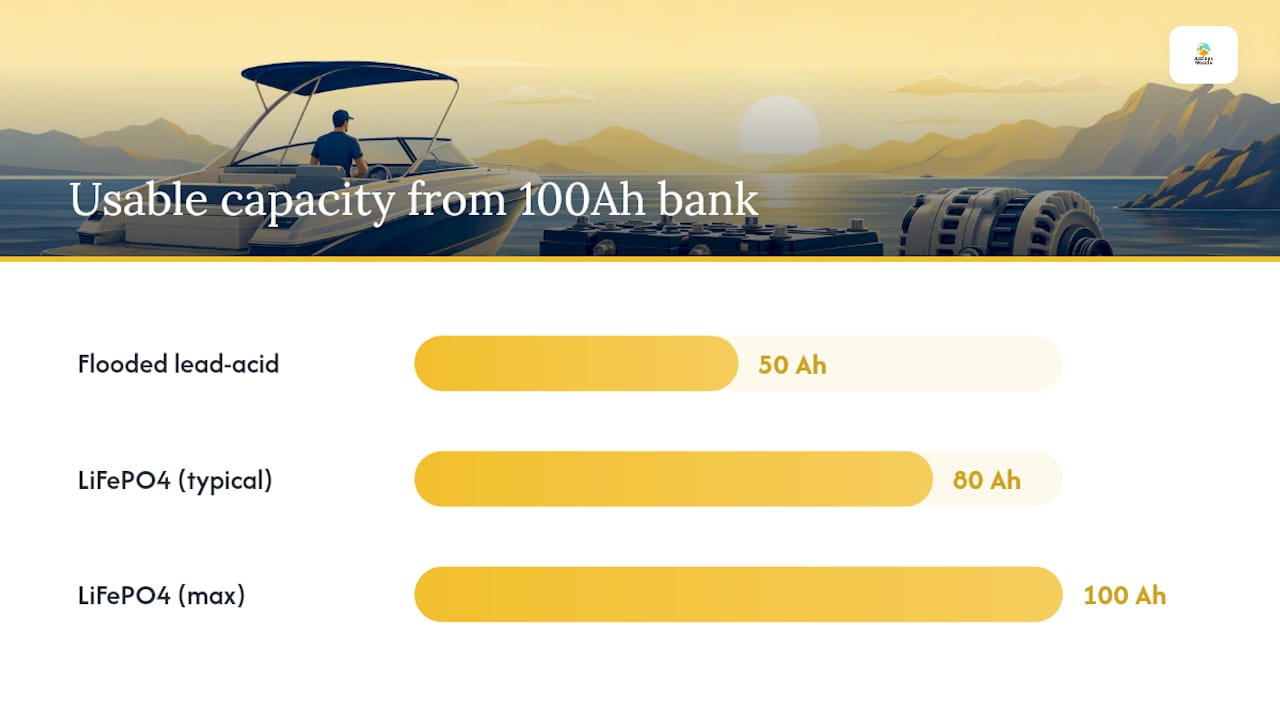
- Amp-hours (Ah) measure total capacity, but usable capacity depends on depth of discharge (DoD). A flooded lead-acid battery is typically only good for 50% DoD before you risk damaging it, while a quality LiFePO4 battery can handle 80 to 100% DoD repeatedly. That means a 100Ah lead-acid battery gives you roughly 50 usable amp-hours, while a 100Ah lithium battery gives you closer to 80 to 100.
- CCA and peak current need to match your starter’s cranking demand, not just exceed it. Check your engine manual for the CCA rating and buy a starting battery that meets or beats it, with some margin for cold mornings.
- Trolling motor amp draw versus Ah is simple math once you know the motor’s rated draw. A 24V, 80-pound-thrust trolling motor pulling around 50 amps at full throttle will drain a 100Ah bank in roughly two hours at full power, less if you’re not running at max speed most of the time.
- Charge acceptance rate determines how fast a battery can safely recharge. Lithium batteries generally accept a much higher charge current than lead-acid without damage, which is part of why they charge faster off the same alternator or charger.
- Group size, terminal type, and hold-down compatibility sound minor until your new battery doesn’t fit the factory tray. Confirm BCI group size and terminal style (top post versus side terminal) before you buy, not after it arrives.
Statistic: Editorial testing from outlets like Wired2Fish’s marine battery buyer’s guide increasingly groups top picks by use case rather than by chemistry alone, reflecting how differently a battery performs under sustained trolling load versus a single cold start.
Pro Tip: Write your engine’s CCA requirement and your trolling motor’s amp draw on a sticky note before you shop. Half the return trips to the marine store happen because someone bought on price instead of spec.
Do You Need a Special Charger for Marine Batteries?
Charging is where a lot of lithium upgrades go wrong. LiFePO4 batteries can accept much higher charge currents than lead-acid, but that speed only helps if the charging source and the battery’s internal battery management system (BMS) are talking to each other correctly.
Most stock alternators were designed decades ago around flooded lead-acid charging curves. They taper output as voltage rises, which lithium batteries don’t need since they hold voltage flat across most of their discharge curve. The result: an old-style alternator sees a lithium battery as never “full,” and it can run too hot for too long trying to keep up. Signs your alternator isn’t cutting it include unusually high case temperatures, a check-engine or charge warning light, or a battery that never reports a full charge on its Bluetooth app.
Here’s how the common charging setups compare:
- Single-bank alternator with isolator: works fine for lead-acid, but often needs a DC-DC charger added for lithium to regulate charge current safely.
- DC-DC chargers: convert the alternator’s variable output into a clean, lithium-appropriate charge profile, protecting the BMS from overcurrent.
- Multi-bank smart chargers: the standard for shore power charging, with separate charge profiles selectable for flooded, AGM, gel, or lithium banks.
- Solar charge controllers: useful for topping off house banks at anchor, but must be lithium-compatible (MPPT with a LiFePO4 profile) to avoid undercharging or tripping the BMS.
Pro Tip: If you’re converting an existing boat to lithium, budget for a DC-DC charger alongside the battery itself. Skipping it is the single most common reason boaters report disappointing lithium performance in their first season.
How Should You Install and Maintain a Marine Battery?
Installation mistakes cause more battery failures than age does, so using marine ceramic coating for boats can help protect surfaces and maintain the battery compartment environment. A battery wired with undersized cable or a missing fuse can fail catastrophically, and marine environments make corrosion an ongoing threat that landlocked installations never deal with.
- Size the wire correctly. Undersized cable causes voltage drop, which forces the alternator or charger to work harder and can starve your starter of the current it needs. Match wire gauge to both amperage and cable run length.
- Fuse close to the battery. A fuse or circuit breaker belongs within a few inches of the positive terminal, before the wire runs anywhere else. That protects the entire circuit, not just the far end of it.
- Use marine-rated, corrosion-resistant connectors. Tinned copper terminals resist the saltwater and humidity that eat through standard automotive connectors within a season or two.
- Mount the battery securely with a proper hold-down. A battery that shifts in rough water can crack a case or short a terminal against a metal bracket.
- Match ventilation to chemistry. Flooded lead-acid batteries vent hydrogen gas and need a ventilated compartment. AGM batteries are sealed and far more tolerant of enclosed mounting. Lithium batteries are fully sealed and need no venting at all, though they still need to stay dry and secured.
- Prevent sulfation in lead-acid batteries during storage by keeping them on a maintenance charger over winter rather than letting them sit at a partial charge, which is what actually kills most flooded batteries before old age does.
- Store lithium batteries at a partial charge, typically 50 to 60%, rather than fully charged or fully dead, and let the BMS handle the rest.
Atticus Goods’ marine wiring guide covers wire sizing charts and fuse placement in more depth if you’re doing the install yourself.
Is Lithium Worth the Higher Price Over Its Lifetime?
The upfront price gap between lead-acid and lithium is real, but it tells only part of the story. What matters is cost per cycle, not cost per battery.
A quality flooded battery typically delivers somewhere in the range of 300 to 500 cycles before capacity drops off noticeably. AGM batteries usually stretch that to 400 to 600 cycles. LiFePO4 batteries are in an entirely different range. Renogy’s Core Series 12V 300Ah LiFePO4 battery is rated for 5,000 cycles at 80% depth of discharge, and some dual-purpose LiFePO4 models push past 6,000 cycles, according to BlueMarine’s Epoch Pro Series listing.
Run the math over a boat’s lifespan and lithium usually wins on cost per usable amp-hour delivered, even with a higher sticker price, because you’re not replacing it every two or three seasons.
- Usable capacity, not rated capacity, is what determines runtime. A 100Ah lead-acid battery at 50% DoD gives roughly the same usable power as a 60Ah lithium battery running at 80 to 100% DoD.
- Warranty length is a real signal of manufacturer confidence. Lead-acid batteries commonly carry one to two-year warranties, while several premium LiFePO4 marine batteries carry warranties running five years or longer.
- Registration requirements matter. Some lithium manufacturers require online product registration within a set window after purchase to activate the full warranty term, so don’t skip that step.
What Should You Know Before Buying a Lithium Marine Battery?
Lithium marine batteries solve real problems, but the marketing around them sometimes outruns the fine print. A few things worth checking before you commit.
BMS continuous rating versus peak rating is the detail most buyers miss. A battery advertised with a 1,000A peak cranking spec for five seconds, a common figure among dual-purpose LiFePO4 batteries per Abyss Battery’s product listings, is not rated for 1,000A continuously. Match the peak spec against your starter’s actual draw, and make sure your wiring and fuse can handle that peak safely too.
Cold weather changes lithium charging rules. Standard LiFePO4 cells should not be charged below freezing, since doing so can permanently damage the cells. That’s why several manufacturers now build in self-heating elements, letting the battery warm itself before accepting a charge in cold conditions, a feature Renogy’s Core Series includes standard. If you winter your boat somewhere cold, a heated lithium model is worth the extra cost over a standard one.
- Look for UL certification or IEC 62619 compliance on the battery’s spec sheet, both signals of independent safety testing.
- Check for ABYC compliance mentions if the battery is being sold specifically for marine use, since ABYC standards cover marine electrical installation practices.
- IP-rated housings (commonly IP65 or IP67) indicate real resistance to splash and spray, not just a marketing claim.
Pro Tip: Bluetooth monitoring apps, now standard on most premium lithium marine batteries, let you check state of charge and BMS fault codes right from your phone. Use it. Catching a BMS warning early beats discovering a dead battery at the ramp.
What Happens to Old Marine Batteries?
Every marine battery eventually needs replacing, and how you dispose of the old one matters more than most boaters realize. Lead-acid batteries, whether flooded or AGM, contain sulfuric acid and lead plates, both hazardous if they end up in a landfill or leach into groundwater. Nearly all auto parts stores and marine retailers accept old lead-acid batteries for recycling, often for free, and many charge a core deposit at purchase specifically to encourage the return of the old unit.

Lithium batteries require more caution. A damaged or punctured LiFePO4 cell can, in rare cases, create a fire risk, so they should never go in household trash or standard recycling bins. Most regions require lithium batteries to go through a dedicated battery recycling program or hazardous waste collection site rather than curbside pickup. Check with your local waste authority or a certified battery recycler before disposing of one.
Recycling matters beyond keeping toxic material out of landfills. Lead from recycled batteries and lithium, cobalt, and nickel recovered from lithium cells all get reused in new battery production, reducing the need for fresh mining. If you’re storing a boat for winter and swapping to a new battery in spring, hold onto the old one until you’ve confirmed a proper recycling drop-off rather than letting it sit in a garage corner indefinitely, since degraded batteries can leak over time.
Buying from a retailer that clearly labels battery chemistry and disposal guidance also makes this easier, since you’ll know exactly what you’re dealing with when replacement day comes.
How Do Marine Battery Brands Compare?
Rather than ranking specific models, it helps to understand the categories brands compete in, since that tells you more about fit than any single spec sheet. Retailer buyer’s guides, including Batteries Plus’s marine battery brand comparison, typically sort options into flooded, AGM, gel, and LiFePO4, then advise buyers to choose based on maintenance tolerance and load profile rather than brand name alone.
Budget flooded and AGM brands dominate the entry-level starting battery market. They’re the safe default for boaters who want a reliable starting battery without a big spend, and AGM in particular has become the practical middle ground: sealed, spill-proof, and far more vibration-resistant than flooded batteries, at a moderate price premium.
Premium AGM brands target trolling motor and house bank use, with thicker plates built for repeated deep discharge. These cost more than basic AGM starting batteries but hold up far better under the daily discharge cycles a trolling motor demands.
Lithium-focused brands have moved fast into dual-purpose and deep-cycle marine categories. Feature sets like Bluetooth monitoring, self-heating, and IP-rated housings, once exclusive to high-end models, are now showing up across a wider range of price points as more manufacturers enter the space.
The practical takeaway: match the category to your use case first, then compare specific models within that category on Ah, warranty, and certifications rather than chasing a brand name across categories it isn’t built for.
How Should You Handle and Store Marine Batteries Safely?
Marine batteries live in a harsher environment than almost any other consumer battery, and handling them wrong creates real risk, not just inconvenience.
Always disconnect the negative terminal first when removing a battery, and reconnect it last when installing one. This order minimizes the chance of a spark near the positive terminal shorting against the boat’s frame. Wear eye protection when handling flooded lead-acid batteries, since they contain sulfuric acid that can splash during removal or a fall.
Never store any marine battery, lead-acid or lithium, in an unventilated enclosed space without checking chemistry-specific requirements first. Flooded batteries release hydrogen gas during charging, which needs somewhere to escape. Lithium batteries don’t vent gas under normal use, but they still shouldn’t be stored somewhere that traps heat, since excessive heat degrades any battery chemistry faster.
Keep metal tools and jewelry away from battery terminals during installation or removal. A wrench that bridges both terminals, even briefly, can cause a short powerful enough to weld itself in place or cause burns. If a battery shows swelling, an unusual odor, or visible case damage, stop using it immediately and isolate it from other equipment rather than continuing to charge or discharge it. Damaged batteries, especially lithium ones, should be handled as potential fire risks until properly assessed or disposed of through a certified recycler.
A marine electronics writer’s take on picking the right battery
Most boaters overthink the chemistry debate and underthink the use case. If you own a simple outboard skiff, don’t overspend on lithium’s weight savings you’ll never notice at that hull size. Put the money into a quality AGM starting battery and call it done. Where lithium earns its keep is bigger boats: bass boats hauling three trolling motor batteries, or cruisers running a fridge and electronics overnight, where the weight and cycle life differences compound trip after trip.
Before you buy anything, run this checklist: confirm the Ah rating against your actual runtime needs, check whether the battery needs a DC-DC charger or BMS-compatible charger, read the warranty term and registration window, verify group size against your battery tray, and check the retailer’s return policy in case fitment is off. Atticus Goods’ battery backup guide and its trolling motor selection guide both walk through fitment questions in more depth if you’re unsure where your setup lands.
— Matthew Vista
Where to Buy the Right Marine Battery for Your Boat
Marine batteries are typically sorted by category—starting, deep-cycle, and dual-purpose lithium—to help buyers find the right fit without scrolling through a generic battery aisle.
Before you check out, run through the same checklist covered above: confirm the group size against your battery tray, look at the BMS specs listed on any lithium product page, and note the warranty term and registration requirements before you install anything. Product pages often include CCA, Ah, weight, and cycle life side by side, making it easier to compare battery options than cross-referencing spec sheets from multiple manufacturer sites. If you’re not sure which category fits your engine or trolling motor, customer support services can help you match specs before you buy, with fast shipping options available to minimize wait times before you can get back on the water. Browse the full marine and boating category to compare current in-stock options and find the battery that matches your setup.
FAQ
What’s the Difference Between a Marine Battery and a Deep-Cycle Battery?
“Marine battery” is a broad category covering starting, deep-cycle, and dual-purpose batteries built for boat use. “Deep-cycle” refers specifically to a discharge pattern, slow and sustained, so not every marine battery is a deep-cycle battery, though every deep-cycle battery designed for boats is a marine battery.
How Many Years Should a Deep-Cycle Marine Battery Last?
A quality AGM deep-cycle battery typically lasts three to five years under normal recreational use, while flooded lead-acid batteries often need replacement closer to the two to four year mark. LiFePO4 deep-cycle batteries commonly last eight to ten years or more, backed by cycle-life ratings as high as 5,000 cycles at 80% DoD on models like Renogy’s Core Series.
What Are the Top Battery Chemistries for Boaters to Know?
Flooded lead-acid, AGM, and LiFePO4 cover the vast majority of the marine battery market. Flooded batteries are the cheapest but need the most maintenance, AGM offers a sealed, low-maintenance middle ground, and LiFePO4 leads on weight, cycle life, and charge speed at a higher upfront price.
What Type of Battery Is Best for Boats Overall?
There’s no single best battery type for every boat, only the best type for your specific use case. Starting-only setups do well with a high-CCA AGM starting battery, trolling motor setups benefit most from deep-cycle AGM or LiFePO4, and boats running overnight house loads see the biggest advantage from high-Ah lithium. Atticus Goods’ battery type guide breaks down which category fits which boat in more detail.