

An NMEA 2000 network is a standardized digital communication protocol that lets marine electronics share data across a single backbone cable. Formally defined under IEC 61162-3, it supports up to 50 devices on one network, replacing the tangle of point-to-point wiring that older systems required. GPS chartplotters, VHF radios, depth sounders, engine monitors, and autopilots can all talk to each other simultaneously. For any marine professional or enthusiast who wants reliable, expandable boat electronics, understanding this standard is the starting point.
What is an NMEA 2000 network and how is it structured?
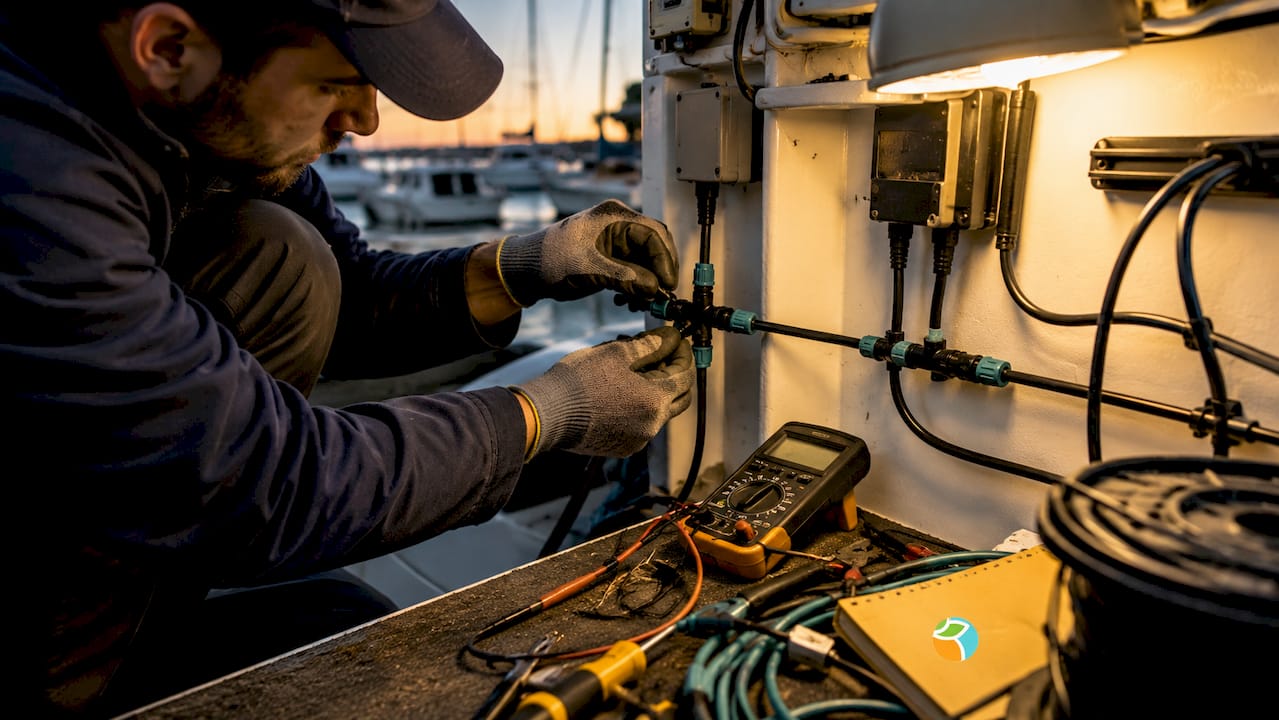
An NMEA 2000 network is built around a single backbone cable that runs the length of the vessel. Every device connects to that backbone through a T-connector and a short drop cable, rather than running separate wires back to a central hub. This topology is the defining physical feature of the standard, and deviating from it causes most of the problems installers encounter.
The National Marine Electronics Association (NMEA) developed the standard in the late 1990s, drawing on automotive networking technology to solve a problem that had plagued boat builders for decades: incompatible wiring between devices from different manufacturers. The result was a plug-and-play architecture where any certified device connects to the backbone and immediately begins sharing data with every other device on the network. A depth sounder reading, for example, feeds directly into a chartplotter without a dedicated wire between the two units.
The IEC 61162-3 designation gives the standard international regulatory standing. That matters for commercial vessels and offshore racing programs that must meet classification society requirements. For recreational boaters, it means any device carrying the NMEA 2000 certification mark will work with any other certified device, regardless of brand.
What are the core components of an NMEA 2000 network?
The physical hardware of a correctly built network follows strict specifications. Getting these right before powering up saves hours of troubleshooting later.
Backbone cable forms the spine of the network. DeviceNet certified cabling is mandatory. It uses a specific conductor size and shielding specification that keeps signal integrity intact in the electrically noisy environment of a marine engine room. Low-quality cable causes corrupted data and intermittent dropouts that are nearly impossible to diagnose without first replacing the cable.
T-connectors attach each device to the backbone. Every connection point requires a T-connector. Splicing wires directly into the backbone or daisy-chaining devices from one to the next violates the topology and introduces signal reflection errors.
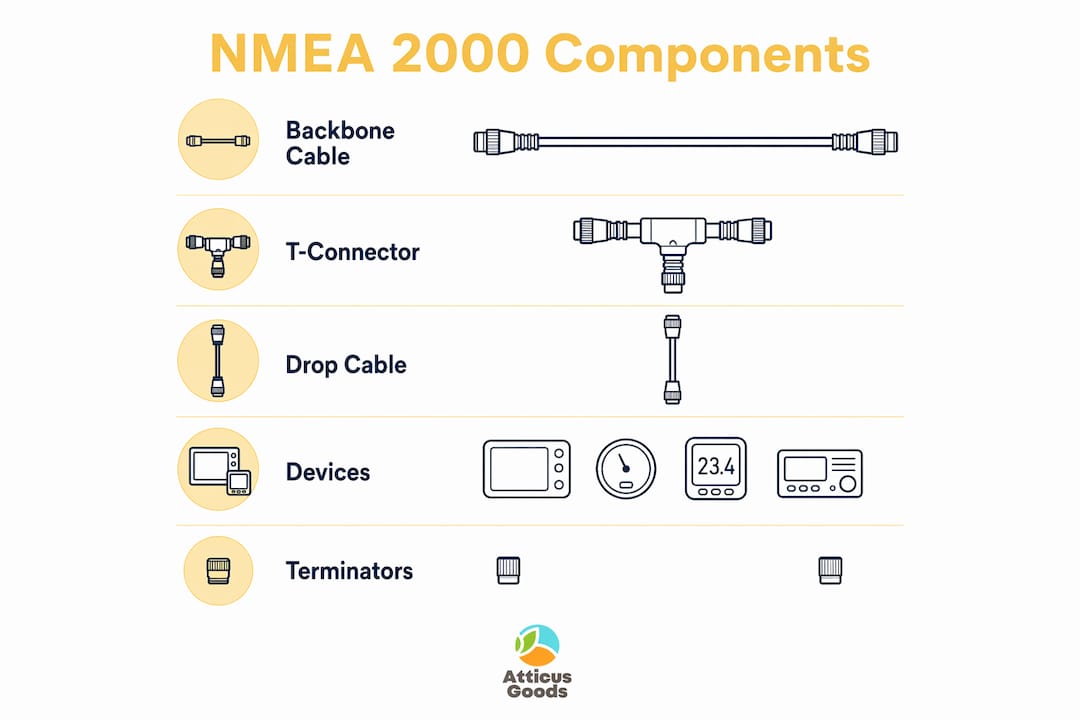
Drop cables run from the T-connector to each device. The maximum drop cable length is 6 meters, and the total combined length of all drop cables on the network must stay under 76 meters. The backbone itself cannot exceed 100 meters.
Terminators go at each end of the backbone. Two terminators are required, one at each end, and they must be 120-ohm resistors. Without both terminators in place, signal reflections corrupt data across the entire network.
Power supply feeds the network through the backbone. The Load Equivalency Number (LEN) system governs how much current each device draws. One LEN equals 0.05 amperes, and the total network is capped at 60 LEN, keeping total current under 3 amperes. Exceeding that limit risks overheating connectors or, in worst cases, fire.
- Backbone cable: DeviceNet certified, maximum 100 meters
- Drop cables: maximum 6 meters each, total under 76 meters
- T-connectors: required at every device connection point
- Terminators: two required, one at each end of the backbone
- Power: maximum 60 LEN total across all connected devices
Pro Tip: Before buying any device, check its LEN rating in the product documentation. Add up the LEN values of every device on your planned network. If the total approaches 60, add a second power insertion point rather than overloading a single feed.
How does NMEA 2000 communication actually work?
The protocol underneath NMEA 2000 is the Controller Area Network (CAN) bus, originally developed for automotive applications. CAN bus provides resistance to electrical interference, which makes it well suited to the high-noise environment near marine engines and alternators. The automotive pedigree also means the protocol has decades of proven reliability behind it.
Data travels across the network as Parameter Group Numbers, or PGNs. Each PGN is a predefined message type with a specific format. PGN 127245 carries rudder angle data. PGN 129029 carries GPS position. Every device on the network broadcasts its relevant PGNs continuously, and every other device listens for the PGNs it needs. No central controller routes the traffic. The network is peer-to-peer.
The advantages over the older NMEA 0183 standard are significant:
- Data speed. NMEA 2000 operates at 250 kilobits per second. NMEA 0183 runs at 4,800 baud in its standard form, roughly 50 times slower. That speed difference matters when a chartplotter is pulling GPS, depth, wind, and engine data simultaneously.
- Multi-device support. NMEA 0183 uses point-to-point connections. One talker, one listener per wire. NMEA 2000 puts all devices on one shared backbone with no wiring penalty for adding more instruments.
- Error checking. CAN bus includes built-in error detection and automatic retransmission. NMEA 0183 has no equivalent mechanism, so corrupted sentences simply disappear.
- Bidirectional communication. NMEA 2000 devices can both send and receive data. NMEA 0183 devices are typically either talkers or listeners, not both.
The practical result is that a modern NMEA 2000 network can feed a single multifunction display with GPS position, vessel speed, depth, wind speed and direction, engine RPM, fuel flow, and autopilot status, all from one cable connection.
What are the benefits and common installation pitfalls?
The primary benefit of an NMEA 2000 network is simplified wiring. A vessel that previously needed eight separate cable runs between instruments now needs one backbone with eight drop cables. That reduction in wire count lowers installation time, reduces potential failure points, and makes troubleshooting far more straightforward.
Reliability is the second major benefit. Most intermittent electronics failures trace back to poor physical installation rather than protocol failure. When the physical layer is correct, the network is extremely stable. Devices can be added or removed while the network is running without disrupting other instruments.
Common installation mistakes fall into predictable categories:
- Missing or extra terminators. A network with one terminator instead of two, or with three terminators, will show constant data errors. Always verify terminator count before commissioning.
- Daisy-chaining devices. Daisy-chained connections create stub branches that cause signal reflections. Ghost data and intermittent dropouts follow. Every device needs its own T-connector on the backbone.
- Non-certified cable. Using standard marine wire instead of DeviceNet cable introduces signal noise that certified cable would reject.
- Voltage drop on long backbones. A 100-meter backbone with many devices can experience voltage drop at the far end. Devices at the end of the backbone may reset or drop off the network.
- Exceeding LEN limits. Adding devices without recalculating total LEN is a fire risk, not just a performance issue.
Network health testing takes two minutes and a multimeter. With the network powered off, measure resistance between the CAN High and CAN Low lines. A correctly terminated network reads approximately 60 ohms. A reading of 120 ohms means one terminator is missing. A reading near zero indicates a short circuit somewhere in the backbone.
Pro Tip: Run this resistance test before you power up any new installation. Catching a wiring error at this stage takes minutes. Diagnosing the same error after devices are installed and the boat is in the water takes hours.
How to plan and expand your NMEA 2000 network
Effective network design starts on paper, not on the boat. Drawing a network diagram before pulling any cable forces you to account for device locations, drop cable lengths, backbone routing, and power insertion points. Skipping this step is the single most common reason networks need to be partially rebuilt after initial installation.
Follow these steps when planning or expanding a network:
- List every device and its LEN rating. Total the LEN values. If the sum exceeds 40, plan for two power insertion points from the start.
- Map the backbone route. Choose the shortest path that reaches all device locations while staying within the 100-meter backbone limit. Route away from engine heat and fuel lines.
- Assign drop cable lengths. Measure the actual distance from each T-connector location to each device. Confirm every drop stays under 6 meters and the total stays under 76 meters.
- Place terminators on the diagram. Mark both ends of the backbone. Order terminators before starting the installation.
- Identify expansion points. If you plan to add devices later, install T-connectors with blanking plugs at those locations now. Adding T-connectors to a live backbone later means disconnecting the network.
| Planning step | Key constraint |
|---|---|
| Device count | Maximum 50 devices per network |
| Backbone length | Maximum 100 meters |
| Drop cable length | Maximum 6 meters per drop |
| Total drop length | Under 76 meters combined |
| Network current | Maximum 60 LEN (3 amperes) |
Expanding an existing network to include devices from manufacturers who use proprietary connectors is straightforward. Adapter cables bridge proprietary connectors to standard NMEA 2000 fittings without replacing the existing backbone or devices. This is common when integrating engine data from manufacturers who use their own CAN-based protocols. Check the marine electrical systems guide for broader context on integrating these systems safely.
For vessels with long backbones or high device counts, adding a second power insertion point midway along the backbone prevents voltage drop at the far end. The second feed connects through a dedicated power cable and T-connector, not by splicing into the backbone wire itself. Review safe marine wiring practices before running any new power feeds on an existing vessel.
Key takeaways
An NMEA 2000 network delivers reliable multi-device data sharing on a single backbone, but only when the physical installation follows IEC 61162-3 specifications exactly.
| Point | Details |
|---|---|
| Standard and device limit | NMEA 2000 (IEC 61162-3) supports up to 50 devices on one backbone cable. |
| Physical constraints | Backbone maximum 100 meters; drop cables maximum 6 meters each; total drops under 76 meters. |
| Power and LEN limits | Total network current must stay under 3 amperes; never exceed 60 LEN across all devices. |
| Termination is critical | Two 120-ohm terminators required at each backbone end; verify with a multimeter before powering up. |
| Expansion via adapters | Proprietary manufacturer cables connect to NMEA 2000 backbones using adapter cables without replacing infrastructure. |
Why physical installation matters more than the protocol
I have seen more NMEA 2000 networks fail from a missing terminator than from any actual protocol issue. The standard itself is solid. CAN bus has been running reliably in cars and industrial equipment for decades. When a marine installer calls the network “unreliable,” the first question I ask is whether they measured backbone resistance before powering up. The answer is almost always no.
The mistake I see most often is organic network growth. A boat leaves the factory with three devices on a proper backbone. The owner adds a depth sounder by daisy-chaining it off an existing device’s connector. Then a VHF radio gets added the same way. Within two seasons, the network is a branching mess of stub cables, and the chartplotter drops data every time the engine starts. The fix is always the same: rebuild the backbone correctly with T-connectors at every junction.
My strongest recommendation is to buy DeviceNet certified cable from a reputable supplier, even when the price difference stings. I have watched installers use standard marine wire to save money, then spend three times the cost in labor diagnosing signal corruption they could not explain. The cable is not a place to cut costs.
One more thing worth knowing: if you are integrating a newer engine management system that uses a proprietary CAN protocol, do not assume it will not work with your NMEA 2000 backbone. Adapter cables exist for most major manufacturers. Check compatibility before assuming you need a full replacement. The network is more flexible than most people realize, as long as the physical foundation is correct.
— Matthew Vista
Marine electronics and NMEA 2000 supplies at Atticus Goods
Atticus Goods carries a broad selection of marine electronics and network accessories suited for both new installations and network upgrades. Whether you need certified backbone cabling, T-connectors, terminators, or compatible marine instruments, the catalog covers the components that make a properly built NMEA 2000 network work.
Atticus Goods ships next-day across the United States, which matters when a network component fails mid-season and the boat needs to be back on the water fast. The site stocks over 70,000 products across marine electronics, networking hardware, and consumer electronics, with competitive pricing and customer reviews to help you choose the right part the first time.
FAQ
What is an NMEA 2000 network in simple terms?
An NMEA 2000 network is a single cable backbone that connects multiple marine electronics devices so they can share data with each other simultaneously. It is standardized under IEC 61162-3 and supports up to 50 devices.
How is NMEA 2000 different from NMEA 0183?
NMEA 2000 runs at 250 kilobits per second, supports multiple devices on one backbone, and includes built-in error checking. NMEA 0183 uses slower point-to-point wiring with no error detection and connects only one talker to one listener per wire.
How do I test if my NMEA 2000 network is working correctly?
Power off the network and use a multimeter to measure resistance between the CAN High and CAN Low data lines. A correctly terminated network reads approximately 60 ohms. Any other reading indicates a termination or wiring problem.
Can I mix devices from different manufacturers on one NMEA 2000 network?
Yes. Any device carrying NMEA 2000 certification connects to the backbone and communicates with all other certified devices. Proprietary connector systems from specific manufacturers can be integrated using adapter cables.
What happens if I exceed the 60 LEN limit on my network?
Exceeding 60 LEN draws more than 3 amperes through the backbone, which can overheat connectors and cables. In severe cases this creates a fire risk. Always calculate total LEN before adding new devices to an existing network.