

For any exposed saltwater application, 316 stainless steel is the correct baseline. Full stop. It resists chloride-induced pitting better than virtually any other common hardware material, holds its structural integrity under load, and when correctly specified and installed, can last 25–30+ years on a working boat. Three things to do right now if you’re mid-build:
- Specify the alloy by exposure zone, not by the label “marine grade” (which has no industry definition).
- Verify the grade on receipt — 304 and 316 look identical; only a PMI test or mill certificate tells them apart.
- Match your fasteners and installation practice to the hardware grade, or the weakest link corrodes first.
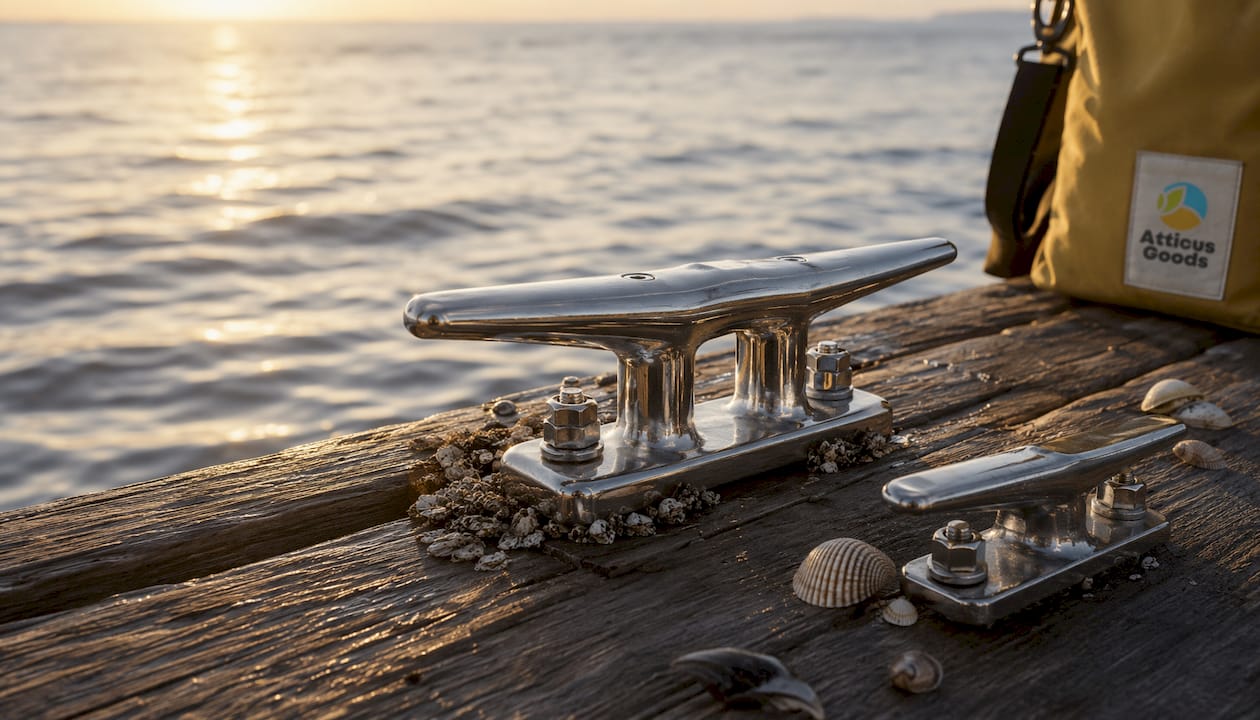
Small fittings — cleats, hinges, fasteners — are frequently the first to fail because builders focus on marquee components and overlook the hardware holding everything together.
Table of Contents
- Why stainless steel outperforms other marine materials
- Which grades to use where: 316, 304, duplex, and PREN explained
- Common failure modes and how to prevent them
- Matching hardware to specific boat components
- DIY installation and maintenance checklist
- Is the premium for higher-grade stainless worth it?
- Why you can trust this guide
- Key Takeaways
- The mistakes DIY builders actually make
- Where to find certified marine hardware
- Authoritative references and further reading
Why stainless steel outperforms other marine materials
The core advantage is the passive film. Stainless steel forms a thin chromium oxide layer on its surface that continuously repairs itself when exposed to oxygen. That self-healing behavior is what separates it from carbon steel, aluminum, and most polymers in a saltwater environment.
Chlorides are the enemy of that film. Seawater’s sodium chloride attacks the passive layer at the microscopic level, creating pits that grow inward. Grade 316 contains 2–3% molybdenum, which stabilizes the passive layer against chloride attack and significantly slows pitting initiation. That’s the chemistry behind why 316 is the minimum for exposed marine hardware.
“Stainless steel’s chromium content creates a protective oxide layer that prevents rust and corrosion. This is especially critical for parts exposed to water that will corrode over time if not properly treated or made from the correct material.” — SPEP
Beyond corrosion resistance, stainless steel carries real mechanical advantages. It absorbs impact energy better than aluminum and holds tensile strength under the dynamic loads a boat sees in rough water. For a DIY builder, that translates to fewer stress fractures at fittings, longer inspection intervals, and lower lifetime maintenance cost compared to bronze or polymer alternatives.
Which grades to use where: 316, 304, duplex, and PREN explained
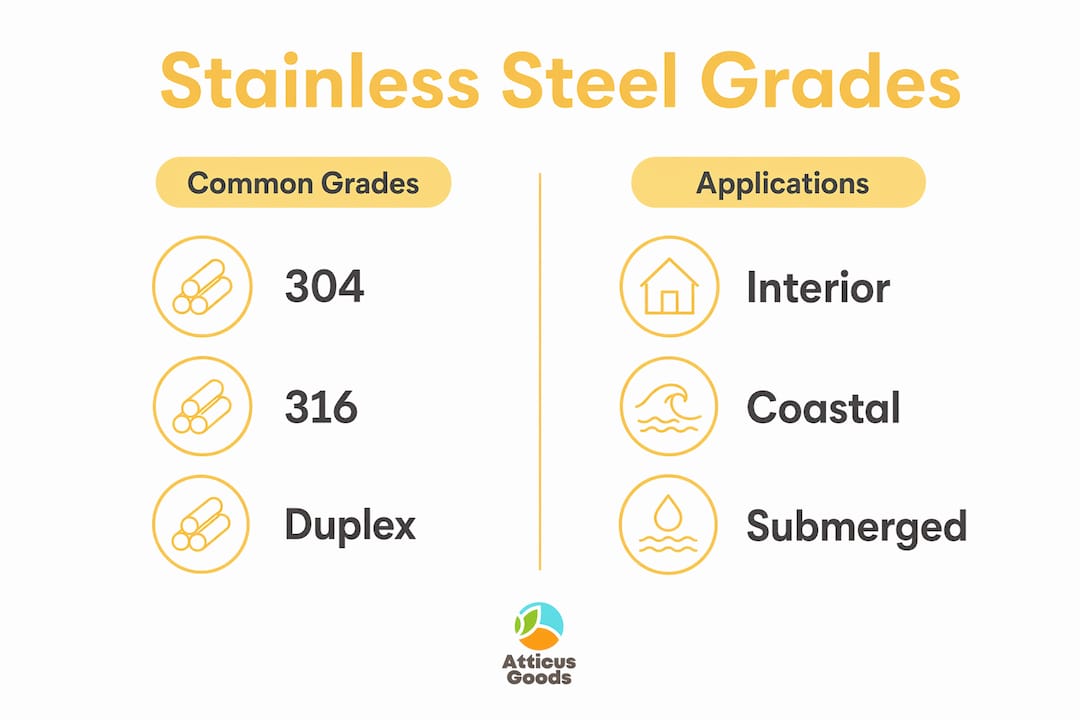
The phrase “marine grade” is marketing, not a specification. There is no industry-recognized definition of it. Professionals specify alloys by PREN and exposure category instead.
PREN stands for Pitting Resistance Equivalent Number. It’s a calculated index based on chromium, molybdenum, and nitrogen content. Higher PREN means better chloride resistance. For submerged seawater service, a PREN above 40 is typically the minimum. For splash-zone and atmospheric exposure, 316’s PREN (roughly 24–26) is adequate as a baseline.
“Specify materials by PREN thresholds appropriate to exposure rather than relying on the marketing phrase ‘marine grade.’” — 2026 industry guidance
| Exposure Zone | Recommended Alloy Family | Notes |
|---|---|---|
| Atmospheric / coastal air | 316 / 316L | Minimum for coastal hardware |
| Splash zone | 316 / 316L | Standard baseline; verify finish quality |
| Intermittent wetting | 316 / 316L | Drainage geometry matters as much as alloy |
| Continuous seawater immersion | Duplex (2205) or super-austenitic | PREN >40 required |
| High-load structural fittings | Duplex (2205) or super-duplex | Strength and corrosion resistance both needed |
304 has its place — interior cabin hardware, freshwater applications, protected enclosures — but it lacks molybdenum and underperforms in salt spray and splash zones. For anything exposed to seawater, treat 316 as the floor, not the ceiling.
Common failure modes and how to prevent them
Stainless steel doesn’t fail the way carbon steel does. It doesn’t rust uniformly. It fails locally, quietly, and often invisibly until a fitting lets go.
- Pitting corrosion: Chlorides break through the passive film at weak points, creating small pits that grow inward. Often starts under washers or at rough weld surfaces.
- Crevice corrosion: Oxygen-depleted zones under gaskets, lap joints, or sealant edges concentrate chlorides and accelerate attack. Geometry is as important as alloy choice here.
- Chloride stress corrosion cracking (CSCC): Tensile stress plus chlorides plus elevated temperature can crack austenitic stainless. Most relevant for rigging and high-load fittings.
- Galvanic corrosion: When stainless contacts a less-noble metal (aluminum, carbon steel) in seawater, the less-noble metal corrodes rapidly. Isolation washers and matching fasteners are the fix.
- Microbiologically influenced corrosion (MIC): Biofilms in stagnant bilge water or poorly drained fittings can accelerate localized attack even on 316.
Design controls that stop most of these: drain water away from joints, avoid trapped crevices, use matching stainless fasteners throughout, and passivate welds after fabrication. Electropolished or properly finished surfaces outperform rough or contaminated ones in every exposure category.
Pro Tip: After any welding or grinding, passivate with a citric acid or nitric acid solution per ASTM A967. Welds that skip this step corrode faster than the parent material — the heat-affected zone loses its passive film and needs it rebuilt.
Matching hardware to specific boat components
Rails and handrails sit in the splash zone constantly. 316 is the right call, with a smooth or electropolished finish to minimize chloride adhesion. For rigging terminals and load-bearing fittings, consider stepping up to duplex 2205 — the combination of higher strength and better PREN handles both the mechanical and corrosion demands.
Fasteners deserve special attention. Failure often starts as small pits hidden under a washer or sealant edge, not as visible rust. Use 316 fasteners throughout exposed assemblies, and apply a thin coat of anti-seize to prevent galling during installation. Never mix stainless fasteners with aluminum backing plates without an isolation washer — galvanic corrosion will eat the aluminum.
“Specification should include grade, finish, thread type, anti-galling approach, compatible mating materials, and maintenance interval. Material choice without installation discipline is incomplete.” — RCGeotech
Submerged fittings — keel bolts, through-hulls, propeller shaft hardware — need PREN above 40. Super-austenitic grades like UNS S31254 or super-duplex grades like UNS S32750 are the proven options for continuous immersion. For mast hardware and deck fittings, 316 works well when drainage is designed in and inspection access is maintained.
DIY installation and maintenance checklist
Installation steps:
- Verify alloy on receipt — request PMI test or mill certificate for critical fittings; visual inspection alone cannot confirm grade.
- Inspect for surface contamination (carbon steel dust, iron particles from transport) and clean before installation.
- Use matching 316 stainless fasteners throughout; never substitute a lower grade at the fastener.
- Install backing plates under deck fittings to distribute load and prevent stress concentration.
- Apply marine sealant to prevent water ingress at deck penetrations, but design for drainage — avoid sealed crevices that trap moisture.
- Torque fasteners to spec; use anti-seize compound on stainless threads to prevent galling.
- Passivate any field welds or ground surfaces before the boat goes in the water.
Maintenance schedule:
| Task | Frequency | Notes |
|---|---|---|
| Freshwater rinse of all hardware | After every saltwater use | Removes chloride deposits before they concentrate |
| Visual inspection for pitting or staining | Quarterly | Check under washers, at weld seams, and sealant edges |
| Detailed inspection of load-bearing fittings | Annually | Look for cracks, deformation, or deep pitting |
| Re-passivation of abraded or welded areas | As needed | Use citric or nitric acid per ASTM A967 |
| Replace hardware showing deep pitting | When detected | Do not wait for structural failure |
Tools and materials every DIY builder should have: torque wrench, anti-seize compound, marine-grade sealant, citric acid passivation solution, isolation washers, and a PMI tester or access to a certified testing service for critical parts.
Is the premium for higher-grade stainless worth it?
Yes, and the math is straightforward even without specific numbers. Correctly specified and installed 316 hardware lasts 25–30+ years. Misapplied hardware — wrong grade, wrong fasteners, poor installation — can fail in 2–5 years. Replacing a cleat or rail fitting is a nuisance. Replacing a rigging terminal that failed at sea is a safety incident.
“Choosing stainless steel fasteners for marine applications is not only about corrosion resistance. It directly affects safety, service life, inspection frequency, and replacement cost in aggressive saltwater conditions.” — RCGeotech
The upfront premium for 316 over 304, or for duplex over 316 in immersion service, is typically recovered within the first replacement cycle you avoid. For a DIY builder putting years of work into a boat, that tradeoff is obvious. Specify correctly once; inspect regularly; replace on condition, not on schedule.
Why you can trust this guide
This article is written by Matthew Vista for Atticus Goods, a U.S.-based marine and electronics retailer with over 90,000 in-stock products and deep experience sourcing certified marine hardware. The guidance here reflects 2026 industry practice on grade selection and PREN-based specification, drawing from reference sources including Wikipedia’s marine grade stainless entry, PW Marine OEM’s grade comparison, and RCGeotech’s fastener selection guide.
“Supply-chain grade substitution is a real risk: 304 can be visually identical to 316, so require PMI or mill certificates for critical fittings.” — PW Marine OEM
Scope and limitations: This is practical DIY guidance for above-water and splash-zone hardware selection. Critical structural systems — keel attachments, mast steps, through-hulls on regulated vessels — should be reviewed by a qualified marine engineer or ABYC-certified technician. Always verify current standards with ASTM, ABYC, or your flag state’s authority before finalizing a specification on a regulated build.
This article is general information, not professional engineering advice. Confirm specifications with a qualified marine professional for your specific vessel and application.
Key Takeaways
316 stainless is the non-negotiable baseline for exposed marine hardware because molybdenum stabilizes its passive film against chlorides, delivering multiple decades of service when correctly specified and installed.
| Point | Details |
|---|---|
| 316 is the minimum | Molybdenum content makes 316 the baseline for any saltwater-exposed fitting; 304 lacks this protection. |
| Use PREN, not “marine grade” | Specify alloys by PREN threshold for your exposure zone; the phrase “marine grade” has no industry definition. |
| Immersion needs PREN >40 | Submerged fittings require duplex or super-austenitic grades; 316 is not adequate for continuous seawater immersion. |
| Installation discipline matters | Matching fasteners, passivated welds, and crevice-free geometry are as important as alloy choice. |
| Atticus Goods stocks certified hardware | Browse marine hardware and boating supplies at Atticus Goods for grade-verified, fast-shipping options across the U.S. |
The mistakes DIY builders actually make
The most common error is buying by appearance. Stainless looks like stainless. A builder picks up a bag of fasteners at a hardware store, assumes they’re 316 because they’re shiny, and installs them in a splash-zone cleat. Two seasons later, the fasteners are pitting and the cleat is loose. The fix costs ten times what the correct fasteners would have.
Second mistake: mixing metals without thinking about galvanic series. Stainless against aluminum in seawater is a reliable way to destroy the aluminum. Isolation washers cost almost nothing. Replacing an aluminum deck fitting costs real time and money.
Third: skipping weld passivation. Builders who grind a weld flush and call it done are leaving a corrosion initiation site. The heat-affected zone around a weld loses its passive film. Without passivation, that zone corrodes faster than everything around it, and the failure looks like a material defect when it’s actually a process defect.
The practical clinician’s tip: before any hardware goes on the boat, wipe it down, inspect it under good light, and check for any orange staining or surface contamination from transport. Carbon steel particles from a supplier’s warehouse can seed early corrosion on otherwise perfect 316. A quick clean before installation costs nothing; replacing corroded hardware mid-season costs a weekend.
Where to find certified marine hardware
Atticus Goods carries a broad selection of marine hardware and boating supplies with next-day shipping across the United States. When you order, here’s what to ask for:
- Grade specification: Confirm 316 or higher; request 316L for welded assemblies.
- PMI or mill certificate: For critical load-bearing fittings, ask for documentation.
- Finish type: Specify electropolished or passivated finish for splash-zone hardware.
- Matching fasteners: Confirm fasteners are the same alloy family as the fitting.
For broader build guidance, the best marine and boat supplies guide at Atticus Goods covers high-impact product categories worth reviewing before you finalize your hardware list.
Authoritative references and further reading
“When the stainless steel will be submerged, a pitting resistance equivalent number greater than 40 is typically specified as the minimum for resistance to seawater.” — Wikipedia: Marine grade stainless
Key sources used in this guide:
- Marine grade stainless — Wikipedia: alloy definitions, PREN thresholds, and exposure categories.
- PW Marine OEM: 304 vs 316 for Marine Hardware: grade chemistry and supply-chain verification.
- DRA Metal: Marine Stainless Grade Selection: service-life data and PREN-based specification practice.
- RCGeotech: Stainless Fasteners for Marine: fastener selection, galvanic risk, and installation discipline.
- Marsh Fasteners: Marine Grade Hardware Guide: small fitting failure patterns and contamination risks.
- Atticus Goods: Why Use Marine Grade Wire: companion guide on why “marine grade” labeling requires scrutiny.
For critical structural or regulated fittings, verify material certificates directly with your supplier and cross-reference ASTM A967 for passivation requirements and ABYC standards for your vessel class.