

Marine grade wire is defined as tinned, stranded copper wire with marine-rated insulation, built specifically to survive the corrosion, vibration, and moisture that destroy standard electrical wiring on boats. If you are working on a DIY marine project, the question of why use marine grade wire has a direct answer: nothing else meets the demands of a saltwater environment. The American Boat and Yacht Council’s ABYC E-11 standard mandates stranded, tinned copper conductors for all marine wiring systems. That requirement exists because automotive wire, even good quality automotive wire, corrodes, cracks, and fails in conditions that marine grade wire handles without issue. Understanding the difference protects your boat, your electronics, and everyone on board.
Why use marine grade wire instead of automotive wire?
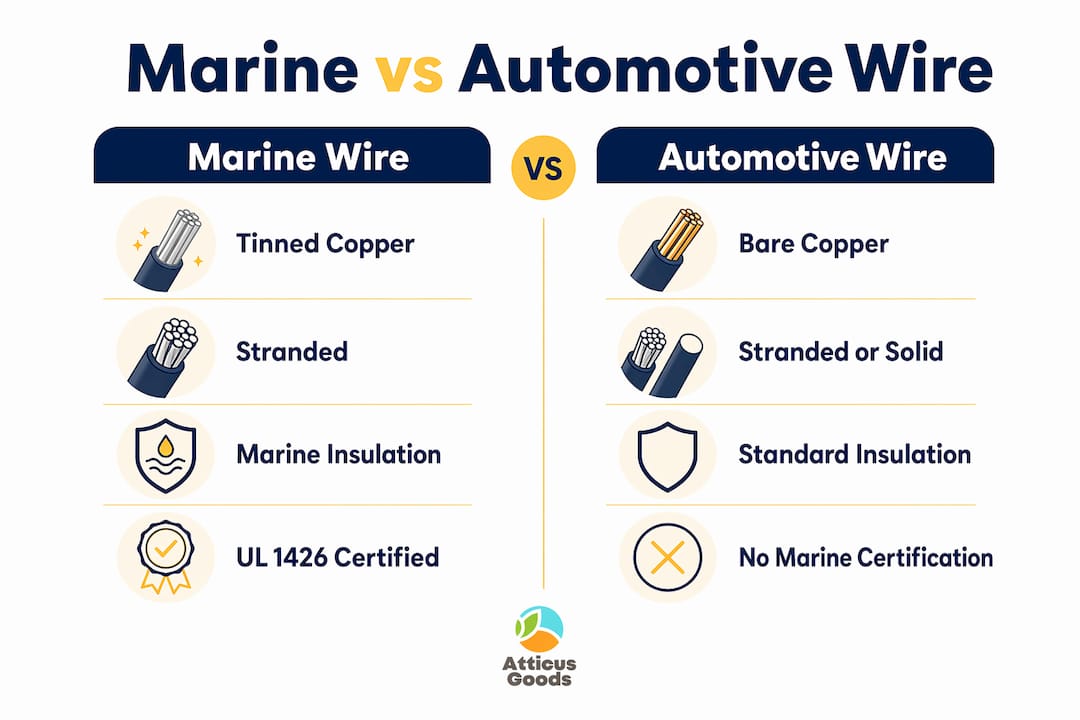
The core difference between marine grade wire and automotive wire comes down to three things: tinning, insulation, and certification. Each one matters in a boat environment.
Tinned copper vs. bare copper
Automotive wire uses bare copper strands. Marine grade wire uses copper strands coated in a thin layer of tin. That tin coating is what prevents “black copper” oxidation, the dark, crusty buildup that increases electrical resistance and causes voltage drop. On a boat, oxidation happens fast. Salt air accelerates galvanic corrosion, and bare copper strands inside a connector can degrade within a single boating season. Tinned copper slows that process dramatically.

Stranded wire vs. solid wire
Marine wiring must never use solid conductor wire because solid wire work-hardens and cracks under the constant vibration of a running engine. Stranded wire flexes without breaking. Automotive primary wire is often stranded, but it lacks the tin coating, which makes it unsuitable below decks. Marine grade wire combines both properties: fine stranding for flexibility and tin plating for corrosion resistance.
Insulation and UL 1426 certification
Marine grade wire carries the UL 1426 label, which confirms the insulation meets marine cable performance standards. Wire without that marking should not be installed below decks. The insulation on marine grade wire resists oil, fuel, and chemicals that are common in engine compartments. Standard wire insulation becomes brittle and cracks under those conditions, creating short-circuit risks.
| Feature | Marine grade wire | Standard automotive wire |
|---|---|---|
| Conductor material | Tinned copper strands | Bare copper strands |
| Insulation rating | UL 1426, oil and chemical resistant | General purpose, not marine rated |
| Vibration tolerance | High, fine stranding | Moderate, may work-harden |
| Corrosion resistance | High, tin plating slows oxidation | Low, bare copper oxidizes quickly |
| ABYC E-11 compliant | Yes | No |
Pro Tip: When buying wire for a boat project, look for both the UL 1426 marking and the ABYC E-11 compliance label on the packaging. If either is missing, the wire is not rated for marine use below decks.
How does marine grade wire prevent electrical problems on boats?
The benefits of marine wire go beyond corrosion resistance. Marine grade wire actively prevents the most common electrical failures that sideline boats and create safety hazards.
Corrosion prevention at the strand level. Tin plating protects each individual copper strand, not just the outer surface of the wire. Moisture can travel inside wire strands through capillary action, wicking along the length of the conductor and corroding it from the inside out. Tinned strands resist that internal corrosion far better than bare copper.
Voltage drop control. Corroded connections increase resistance, and increased resistance causes voltage drop. ABYC E-11 sets strict limits: 3% voltage drop for critical circuits and 10% for non-critical circuits. A bilge pump running on degraded wiring may not generate enough flow to keep up with incoming water. A VHF radio with excessive voltage drop may cut out during an emergency call. Marine grade wire maintains low resistance over time, keeping critical systems performing at full capacity.
Heat resistance in engine compartments. Engine rooms routinely exceed 100°C. Standard wire insulation softens, melts, or cracks at those temperatures. Marine grade insulation is rated to handle that thermal load without degrading. The tin coating on the copper also protects the conductor from thermal oxidation at high temperatures.
Vibration tolerance over years of use. Every time your engine runs, every wave your hull crosses, the wiring flexes. Fine-stranded marine grade wire handles thousands of flex cycles without breaking. Solid wire or coarse-stranded automotive wire develops micro-cracks over time, leading to intermittent failures that are extremely difficult to diagnose.
The combined effect of these properties is a wiring system that requires far less corrective maintenance. Fewer failed connections mean fewer hours tracing faults and fewer unplanned repair bills.
What are the ABYC standards and best practices for installing marine wire?
Knowing the standards before you start a wiring project saves you from costly mistakes. ABYC E-11 is the governing document for marine electrical systems in the United States, and it covers far more than just wire type.
-
Size wire for ampacity and length. Wire gauge must handle the load current without exceeding its ampacity rating. Longer wire runs require a larger gauge to stay within the 3% voltage drop limit for critical circuits. Use an ABYC-compliant wire sizing chart that accounts for both current and run length. Undersized wire overheats and creates a fire risk.
-
Protect circuits with properly sized fuses. ABYC E-11 requires overcurrent protection within 7 inches of the power source. The fuse must be sized to the wire’s ampacity, not the load. A 10-amp fuse on a wire rated for 8 amps defeats the purpose entirely.
-
Use adhesive-lined heat-shrink terminals on every connection. Moisture penetrates wire strands via capillary action, even through tinned conductors. Adhesive-lined heat-shrink terminals create a hermetic seal around the connection, blocking moisture entry at the termination point. Standard crimp connectors leave the wire end exposed. For more on sealing connections properly, the guide on waterproof marine connectors covers the full range of options.
-
Route wire away from heat and sharp edges. Even marine grade insulation degrades faster when pressed against a hot exhaust riser or a sharp metal edge. Use wire loom, grommets, and proper clamps to protect runs through bulkheads and near heat sources.
-
Label every circuit at both ends. This is not a code requirement, but it saves hours of troubleshooting later. A labeled wiring system is a maintained wiring system.
Pro Tip: Treating a boat’s wiring like automotive wiring is one of the most common and expensive mistakes DIY boaters make. Marine wire is engineered for salt, vibration, and moisture. Automotive wire is not. The environments are fundamentally different.
Is marine grade wire worth the extra cost?
Marine grade wire costs more upfront than automotive wire. That price difference is real, and for a large rewiring project it adds up. The question is what you are comparing it to.
- Labor costs for rewiring. Chasing corroded connections in inaccessible areas of a boat is some of the most expensive marine repair work. The price premium of marine grade wire offsets those labor costs directly. One rewiring job on a mid-size cruiser costs far more than the difference between marine and automotive wire on the original installation.
- Fire risk from degraded wiring. Electrical fires are one of the leading causes of boat loss. Degraded insulation and corroded connections create arcing and heat buildup. Marine grade wire with proper installation dramatically reduces that risk.
- System reliability on the water. A failed bilge pump, a dead VHF radio, or a navigation light that cuts out at night are not just inconveniences. They are safety failures. Marine grade wire keeps those systems running when you need them.
- Resale value. Boats with documented, standards-compliant wiring sell more easily and at better prices. Buyers and surveyors look at wiring quality as a proxy for overall maintenance standards.
For DIY boaters, the math is straightforward. Spend a little more on the right wire now, or spend a lot more on repairs and potential safety incidents later. For a practical overview of how all these components fit together, the marine electrical systems guide at Atticus Goods walks through full system design from the ground up.
Key Takeaways
Marine grade wire is the only wiring type that meets ABYC E-11 requirements, resists marine corrosion, and maintains safe voltage levels across all critical boat circuits.
| Point | Details |
|---|---|
| ABYC E-11 compliance | Only tinned, stranded copper wire with UL 1426 insulation meets the standard for below-deck marine use. |
| Corrosion resistance | Tin plating prevents black copper oxidation and resists internal corrosion from capillary moisture. |
| Voltage drop control | Marine grade wire maintains low resistance, keeping critical circuits within the 3% ABYC voltage drop limit. |
| Proper terminations required | Adhesive-lined heat-shrink terminals are mandatory to seal connections against moisture intrusion. |
| Long-term cost advantage | Higher upfront wire cost prevents expensive rewires, fire risk, and system failures over the boat’s life. |
What I’ve learned from watching DIYers wire boats the wrong way
The most common mistake I see in DIY marine wiring is not a wiring mistake at all. It is a shopping mistake. Someone heads to an auto parts store, buys a spool of primary wire because it looks identical to marine wire, and installs it throughout their boat. Two seasons later, they are tracing intermittent failures through corroded connections buried behind panels they have to remove with a screwdriver and a flashlight.
The wire looked fine going in. That is the problem. Automotive wire fails slowly and invisibly. The tin coating on marine grade wire is not visible to the naked eye either, but its absence shows up in your connections within a year or two in a saltwater environment. By the time you can see the corrosion, the damage is already done.
My honest recommendation: never compromise on the wire itself. It is the one component you cannot easily replace after installation. You can upgrade a switch panel. You can add a better fuse block. Rewiring a boat that has been fully fitted out is a project that costs multiples of what the original wire savings were worth.
The other thing I have learned is that even the best marine grade wire fails without quality terminations. Tinned wire is a preventative strategy, not a complete solution. Proper circuit design and sealed terminations are what complete the system. Wire quality and installation quality are not separate decisions. They are the same decision.
— Matthew Vista
Marine grade wire and supplies at Atticus Goods
Atticus Goods stocks a broad selection of marine electrical supplies for DIY boaters who want to wire their boats correctly the first time.
Whether you are rewiring a single circuit or tackling a full electrical system build, Atticus Goods carries marine wiring products aligned with ABYC standards and UL 1426 certification requirements. The catalog covers wire, connectors, terminals, and accessories, all available with next-day shipping across the United States. For a complete overview of what to look for before you buy, the boat owner’s wiring guide at Atticus Goods covers selection, sizing, and installation in practical detail.
FAQ
What is marine grade wire made of?
Marine grade wire is made of tinned, stranded copper conductors with oil-resistant, marine-rated insulation. It carries the UL 1426 certification, confirming it meets marine cable performance standards for below-deck installation.
Can I use automotive wire on my boat?
Automotive wire is not suitable for marine use below decks. It lacks tin plating, making it vulnerable to rapid corrosion in saltwater environments, and it does not meet ABYC E-11 requirements for marine electrical systems.
What does ABYC E-11 require for marine wiring?
ABYC E-11 requires stranded, tinned copper conductors, voltage drop limits of 3% for critical circuits and 10% for non-critical circuits, and overcurrent protection within 7 inches of the power source.
Why do marine wire connections need heat-shrink terminals?
Moisture travels inside wire strands through capillary action, even in tinned wire. Adhesive-lined heat-shrink terminals create a hermetic seal at the termination point, blocking moisture from entering the conductor.
How do I choose the right gauge of marine wire?
Wire gauge selection depends on both the load current and the length of the wire run. Use an ABYC-compliant sizing chart that accounts for both factors to stay within the 3% voltage drop limit for critical circuits.